


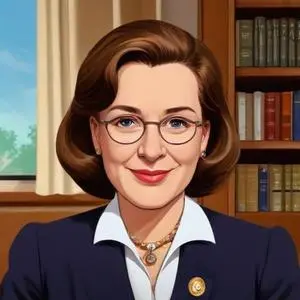
A brilliant codebreaker and coin enthusiast who helped crack the German Enigma code during WWII, making significant contributions to Allied victory.
Joan Clarke, the brilliant British cryptanalyst, is famously known for her pivotal role in deciphering the impenetrable Enigma code during World War II. Clarke's groundbreaking work at Bletchley Park, alongside the legendary Alan Turing, helped turn the tide of the war, earning her numerous accolades and cementing her place in history as a pioneering codebreaker.
Born on June 24, 1917, in West Norwood, London, Joan Elisabeth Lowther Clarke was the youngest of five children to Reverend William Kemp Lowther Clarke and Dorothy (née Fulford). Clarke's academic prowess was evident from an early age, and she attended Dulwich High School for Girls, followed by Newnham College, Cambridge, where she won a scholarship in 1936.
Her exceptional work in an undergraduate geometry class caught the attention of mathematician Gordon Welchman, who would later become her academic supervisor. Clarke's double first degree in mathematics earned her the Philippa Fawcett prize and a Helen Gladstone scholarship for further study. Although Cambridge denied her a full degree due to the then-prevailing gender bias, Clarke's academic achievements paved the way for her remarkable career in cryptography.
In 1940, Welchman recruited Clarke to the Government Code and Cypher School (GCCS), where she joined the elite team tasked with cracking the German Enigma code. Initially placed in an all-women group, Clarke's remarkable skills soon led to her collaboration with Alan Turing, and together they made significant breakthroughs in deciphering the Enigma messages.
Clarke's work at Bletchley Park was instrumental in shortening the war, and her contributions were recognized with the appointment as a Member of the Order of the British Empire (MBE) in 1946. Although she never sought the spotlight, her remarkable achievements earned her numerous citations and accolades.
Joan Clarke's pioneering work in cryptography paved the way for future generations of codebreakers and cryptanalysts. Her contributions to the war effort shortened the conflict, saving countless lives and shaping the course of history.
Today, Clarke's legacy extends beyond the realm of cryptography, inspiring women to pursue careers in STEM fields and serving as a testament to the power of dedication, perseverance, and intellectual curiosity.
"I was lucky enough to be in the right place at the right time, and I was able to make a contribution." - Joan Clarke
Clarke's humility and dedication to her craft continue to inspire generations, serving as a poignant reminder of the transformative power of human ingenuity and determination.
Born in 1912
Pioneering mathematician and computer scientist who cracked the German Enigma code during WWII and laid the foundations for modern computer science and artificial intelligence.
Born in 1906
A British mathematician and computer scientist who played a crucial role in cracking the German Enigma code during World War II, and later wrote about his experiences.
Born in 1917
Noted baseball player and scout who played for several teams and later discovered talented players like Lou Brock and Lee Smith. Known for his keen eye for talent and contributions to the game.
Born in 1917
A brilliant codebreaker and coin enthusiast who helped crack the German Enigma code during WWII, making significant contributions to Allied victory.
