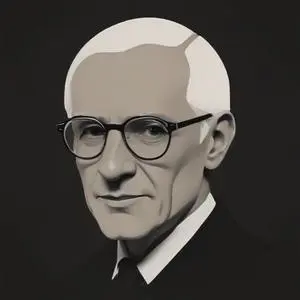
Alonzo Church: The Visionary Mathematician and Logician
A Legacy of Groundbreaking Contributions
Alonzo Church is renowned for his profound impact on the foundations of theoretical computer science and mathematical logic. He is perhaps best known for developing the lambda calculus, formulating the Church-Turing thesis, and providing a solution to the Entscheidungsproblem decision problem.
Early Life and Education
Church was born on June 14, 1903, in Washington, D.C., to Samuel Robbins Church, a justice of the peace and judge of the Municipal Court for the District of Columbia. His family had a strong academic tradition, with his great-grandfather being a professor of Mathematics and Astronomy and the 6th President of the University of Georgia. Church's early life was marked by a tragic accident that left him partially blinded, but he persevered and went on to attend the private Ridgefield School for Boys in Connecticut. He later graduated from Princeton University in 1924 with a degree in mathematics and subsequently earned his Ph.D. in mathematics in 1927 under the guidance of
Oswald Veblen.
Academic Career and Achievements
Church's academic career was marked by numerous achievements, including the development of the lambda calculus, a system for expressing functions and performing computations. He also formulated the Church-Turing thesis, which posits that any effectively calculable function can be computed by a Turing machine. Additionally, he provided a solution to the Entscheidungsproblem, a decision problem in mathematical logic. Church's work had a profound impact on the development of computer science, and he is considered one of the founders of the field, alongside his doctoral student
Alan Turing.
Philosophical Contributions and Beliefs
Church's work was not limited to mathematical logic and computer science. He also made significant contributions to philosophical logic, particularly in the area of intensional logic. His work on the Frege-Church ontology, which is a formal system for representing meaning and reference, has had a lasting impact on the field of philosophical logic.
Influence on Modern Society
Church's work has had a profound impact on modern society, from the development of computers and programming languages to the creation of artificial intelligence and machine learning algorithms. His ideas have permeated many areas of modern life, from e-commerce and finance to healthcare and education.
Personal Milestones and Key Life Events
Church married Mary Julia Kuczinski in 1925, and the couple had three children. He was a devoted family man and was known for his kind and gentle nature. Despite his many achievements, Church remained humble and unassuming, preferring to focus on his work rather than seeking to draw attention to himself.
Controversies and Public Perception
Church's work was not without controversy, however. Some critics argued that his ideas were too abstract and had limited practical applications. However, his defenders countered that his work provided a necessary foundation for the development of modern computer science and artificial intelligence.
Quotes and Memorable Sayings
Church was known for his wit and humility, often remarking that "mathematics is a language, and like any language, it can be used to say trivial things." He also believed that "the most important thing in mathematics is not to be clever, but to be clear."
Historical Context and Legacy
Church's work must be seen within the broader historical context of the development of modern mathematics and computer science. His ideas built upon those of earlier mathematicians and logicians, such as
Gottlob Frege and
Bertrand Russell, and paved the way for later researchers, such as Alan Turing and
John von Neumann.
Comparative Analysis with Contemporaries
Church's work is often compared to that of his contemporaries, such as
Kurt Gödel and Alan Turing. While Gödel's work focused on the foundations of mathematics, Church's work explored the boundaries of computability and the nature of meaning and reference. Turing's work, on the other hand, focused on the development of computers and artificial intelligence.
Career Highlights and Major Works
Church's major works include:
- Lambda Calculus, a system for expressing functions and performing computations
- The Church-Turing Thesis, a proposal that any effectively calculable function can be computed by a Turing machine
- The Entscheidungsproblem, a solution to the decision problem in mathematical logic
- The Frege-Church Ontology, a formal system for representing meaning and reference
Awards and Honors
Church received numerous awards and honors for his work, including the National Medal of Science in 1974.
Impact on Their Field
Church's work has had a profound and lasting impact on the development of computer science, mathematical logic, and philosophy. His ideas continue to influence researchers today, and his legacy serves as a testament to the power of human ingenuity and creativity.