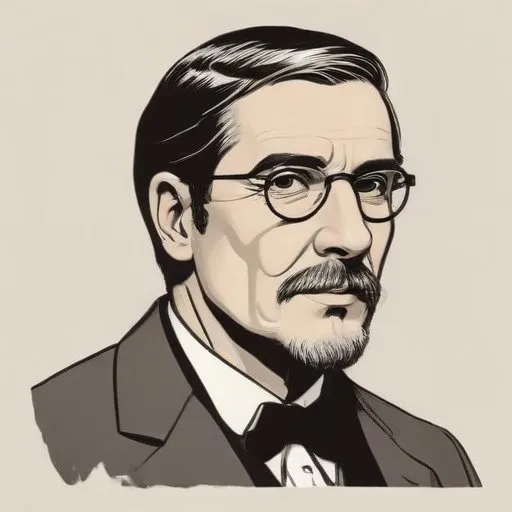
Oswald Veblen

Oswald Veblen

Oswald Veblen was born on June 24th, 1880

Full Name: Oswald Veblen
Occupation: Mathematician and Academic
Nationality: American
Born: June 24, 1880
Died: August 10, 1960
Notable Work: Topology and geometry
Place of Birth: Decorah, Iowa
Zodiac Sign: Cancer

Developed innovative mathematical concepts, particularly in geometry and topology, and played a crucial role in shaping the mathematical community through his academic leadership.

Timeline
1880
Born in the USA
Oswald Veblen was born on June 24, 1880, in Decorah, Iowa, USA.
1903
Earned Ph.D. from the University of Chicago
Veblen earned his Ph.D. in mathematics from the University of Chicago.
1910
Published Theory of Plane Curves
Veblen published his book Theory of Plane Curves, a comprehensive treatment of the subject.
1926
Founded the Institute for Advanced Study
Veblen was a co-founder of the Institute for Advanced Study at Princeton University, a leading center for mathematical research.
1960
Died in New Jersey
Veblen died on August 11, 1960, in Princeton, New Jersey.
Oswald Veblen

Oswald Veblen Quiz

What area of mathematics did Oswald Veblen primarily contribute to?

Score: 0/5
FAQ
What was Oswald Veblens contribution to mathematics?
Oswald Veblen was an American mathematician and academic who made significant contributions to the field of mathematics, particularly in the areas of geometry and topology.
What was Oswald Veblens role in the development of topology?
Oswald Veblen played a key role in the development of topology, a branch of mathematics that studies the properties of shapes and spaces.
What was Oswald Veblens relationship with the Institute for Advanced Study?
Oswald Veblen was one of the founding faculty members of the Institute for Advanced Study, a prestigious research institution in Princeton, New Jersey.
What was Oswald Veblens teaching philosophy?
Oswald Veblen was known for his rigorous and demanding teaching style, which emphasized the importance of mathematical rigor and intellectual curiosity.
What is Oswald Veblens legacy?
Oswald Veblens legacy is one of mathematical excellence and intellectual leadership. He played a significant role in shaping American mathematics in the 20th century, and his work continues to influence mathematicians today.

Related People:

John von Neumann

Born in 1903

Pioneering mathematician and physicist who developed the concept of the modern computer architecture and made significant contributions to quantum mechanics and game theory. His work laid the foundation for modern computing and artificial intelligence.

Kurt Gödel

Born in 1906

A groundbreaking logician and philosopher who shook the foundations of mathematics with his incompleteness theorems, proving that no formal system can be both complete and consistent.

Emmy Noether

Born in 1882

A pioneering mathematician and physicist who revolutionized abstract algebra and made groundbreaking contributions to modern physics, particularly in the development of Einstein's theory of general relativity.

Hermann Weyl

Born in 1885

A pioneer in combining mathematics and physics, known for his work on quantum mechanics, relativity, and the philosophy of science. He introduced the concept of gauge theory, which is crucial in modern particle physics.

Norbert Wiener

Born in 1894

Pioneering mathematician and philosopher who laid the foundations for cybernetics, exploring the intersection of humans, machines, and society. His work has far-reaching implications for artificial intelligence, automation, and modern technology.

John Milnor

95 Years Old

A renowned mathematician and academic who made groundbreaking contributions to topology, differential geometry, and algebraic K-theory, earning him a Fields Medal and Abel Prize.

Atle Selberg

Born in 1917

A renowned mathematician who made significant contributions to number theory, particularly in the development of the Selberg trace formula, and was awarded the Fields Medal and the Abel Prize.

Andrew Wiles

73 Years Old

Proved Fermat's Last Theorem, a problem that went unsolved for over 350 years, and made significant contributions to number theory. His work has far-reaching implications for mathematics and cryptography.