


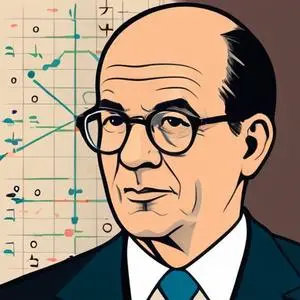
Pioneering mathematician and physicist who developed the concept of the modern computer architecture and made significant contributions to quantum mechanics and game theory. His work laid the foundation for modern computing and artificial intelligence.
John von Neumann, a Hungarian-American mathematician, physicist, computer scientist, and engineer, is renowned for his groundbreaking contributions to the development of modern computing, economics, and quantum physics. His work laid the foundation for the digital computer, game theory, and the mathematical framework of quantum mechanics, earning him the title of one of the most influential mathematicians of the 20th century.
Born on December 28, 1903, in Budapest, Hungary, von Neumann demonstrated exceptional mathematical talent from an early age. He pursued higher education in mathematics and physics at the University of Budapest and later at the University of Berlin, where he earned his Ph.D. in mathematics in 1926.
Von Neumann's remarkable career was marked by numerous achievements in various fields:
Von Neumann's work has had far-reaching implications for modern society:
His contributions to computer science and game theory have shaped the development of artificial intelligence, cryptography, and modern economic systems. His work on the hydrogen bomb and nuclear weaponry has had a profound impact on international relations and global security.
Von Neumann was known for his exceptional intelligence, humor, and charisma. He was a chain smoker and had a reputation for being able to perform complex mathematical calculations in his head. His friends and colleagues often joked that he could calculate the trajectory of a thrown object more accurately than anyone else.
Von Neumann's philosophical views were shaped by his fascination with the limits of human knowledge and the nature of consciousness. He believed that the human brain's ability to process information was fundamentally limited, and that computers could potentially surpass human intelligence in the future.
Von Neumann was awarded numerous honors and accolades for his contributions, including:
Von Neumann's legacy extends beyond his technical contributions. He played a key role in shaping the post-war scientific landscape, serving as a consultant to the U.S. government on issues related to nuclear energy and national security. His influence on modern computing, economics, and quantum physics has been profound, and his work continues to inspire new generations of scientists and researchers.
Von Neumann's contributions are often compared to those of his contemporaries, such as Alan Turing and Norbert Wiener. While Turing is credited with developing the theoretical foundations of modern computer science, von Neumann's work on the von Neumann architecture and universal constructor has had a more direct impact on the development of modern computers. Wiener's work on cybernetics and control theory shares similarities with von Neumann's work on game theory and economics.
Did you know that von Neumann was a naturalized U.S. citizen and spoke five languages fluently, including Hungarian, German, English, French, and Italian?
Despite his many achievements, von Neumann was known to be humble and unassuming. He often referred to himself as a "mathematical lawyer," emphasizing his role as a problem-solver rather than a theoretical mathematician.
Born in 1912
Pioneering mathematician and computer scientist who cracked the German Enigma code during WWII and laid the foundations for modern computer science and artificial intelligence.
Born in 1906
A groundbreaking logician and philosopher who shook the foundations of mathematics with his incompleteness theorems, proving that no formal system can be both complete and consistent.
Born in 1882
A pioneering mathematician and physicist who revolutionized abstract algebra and made groundbreaking contributions to modern physics, particularly in the development of Einstein's theory of general relativity.
Born in 1862
A renowned mathematician and academic who developed infinite-dimensional vector spaces and laid the foundation for quantum mechanics and relativity. He's also famous for his 23 unsolved math problems that shaped 20th-century mathematics.
Born in 1902
A Hungarian physicist and mathematician who made groundbreaking contributions to quantum mechanics and nuclear physics, and was awarded the Nobel Prize in Physics in 1963.
Born in 1918
A brilliant physicist and engineer who pioneered quantum mechanics and famously explained complex concepts in simple terms, making science accessible to all.
Born in 1867
A pioneering scientist who pioneered radioactivity research, discovering elements polonium and radium, and paving the way for breakthroughs in medicine and energy.
Born in 1879
A brilliant physicist who developed the theory of relativity and is considered one of the most influential scientists of the 20th century, known for his groundbreaking work in physics and mathematics.
