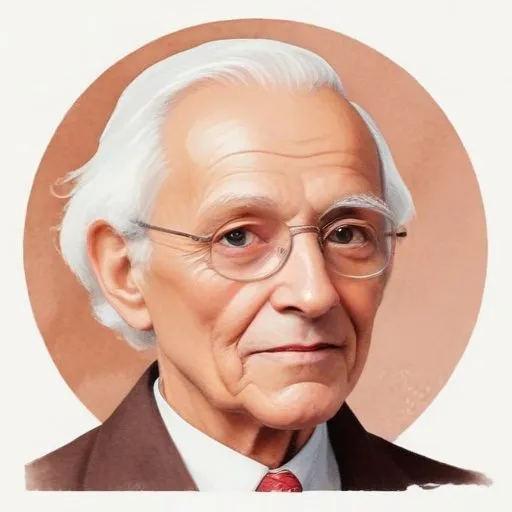
Haskell Curry: The Pioneering Mathematician and Logician
A Legacy of Combinatory Logic and Beyond
Haskell Brooks Curry is renowned for his groundbreaking work in combinatory logic, a field that has far-reaching implications in mathematics, computer science, and philosophy. His contributions to the development of combinatory logic, Curry's paradox, and the Curry-Howard correspondence have cemented his place as one of the most influential mathematicians and logicians of the 20th century.
Early Life and Education
Born on September 12, 1900, in Millis, Massachusetts, Curry grew up in an environment that fostered a love for learning. His parents, Samuel Silas Curry and Anna Baright Curry, were educators who ran a school for elocution. Curry's academic journey began at Harvard University, where he initially pursued a degree in medicine but soon switched to mathematics. He graduated in 1920 and went on to earn a Master of Arts in physics from Harvard in 1924.
The Birth of Combinatory Logic
Curry's fascination with mathematical logic began when he was introduced to the Principia Mathematica, a seminal work by
Alfred North Whitehead and
Bertrand Russell. During his graduate work in electrical engineering at MIT, Curry's interests shifted towards logic, and he eventually pursued a Ph.D. in mathematics at Harvard. His research focused on differential equations, but his true passion lay in logic. In 1927, while an instructor at Princeton University, Curry discovered the work of Moses Schnfinkel in combinatory logic. Schnfinkel's work had anticipated much of Curry's own research, and he soon found himself drawn to the University of Göttingen, where he could work with
Heinrich Behmann and Paul Bernays, who were familiar with Schnfinkel's work.
A Scholarly Odyssey
Under the supervision of
David Hilbert, Curry worked closely with Bernays, receiving his Ph.D. in 1930 with a dissertation on combinatory logic. This marked the beginning of a lifelong journey into the realm of combinatory logic, which would ultimately lead to the development of three programming languages – Haskell, Brook, and Curry – and the concept of currying, a method to transform functions used in mathematics and computer science.
Career Highlights and Major Works
- Combinatory Logic, Vol. 1 (1963) – a monumental work that showcased Curry's extensive research on the subject
- The Consistency of a System of Church's (1941) – a paper that demonstrated the consistency of Church's system of lambda calculus
- Foundations of Mathematical Logic (1963) – a comprehensive textbook on mathematical logic that remains a classic in the field
Influence on Modern Society
Curry's work has had a profound impact on modern computer science, programming languages, and mathematical logic. The programming languages Haskell, Brook, and Curry are a testament to his influence, and his concepts, such as currying, continue to shape the field of computer science. Moreover, his work on combinatory logic has far-reaching implications for artificial intelligence, cryptography, and computer networks.
Personal Life and Milestones
In 1928, Curry married Mary Virginia Wheatley, and the couple had a lifelong partnership that supported his academic pursuits. Apart from his academic achievements, Curry was known for his kindness, humility, and dedication to his students.
Legacy and Impact
Haskell Curry's contributions to combinatory logic, mathematical logic, and computer science have left an indelible mark on the scientific community. His work continues to inspire new generations of mathematicians, logicians, and computer scientists, and his legacy serves as a testament to the power of human ingenuity and intellectual curiosity.
Quotes and Memorable Sayings
- "The importance of a concept does not lie in its complexity, but in its simplicity and universality."
- "Mathematics is not a spectator sport; it is a participatory art."
Historical Context and Legacy
Curry's work was deeply rooted in the intellectual landscape of the early 20th century, which saw the rise of mathematical logic, philosophy, and computer science. His contributions to these fields have ensured that his legacy continues to shape the course of modern science and technology. As a pioneer in the field of combinatory logic, Curry's work has paved the way for future generations of scholars and researchers to explore and innovate.
Awards and Honors
- Fellow of the American Academy of Arts and Sciences (1958)
- Member of the National Academy of Sciences (1968)
FAQ
What were Haskell Currys contributions to mathematics?
Haskell Curry was an American mathematician, logician, and academic who made significant contributions to mathematics, particularly in the fields of logic and category theory. His work on combinatory logic and the Curry-Howard correspondence has had a profound impact on computer science and theoretical mathematics.
What is the Curry-Howard correspondence?
The Curry-Howard correspondence is a fundamental concept in theoretical computer science, which establishes a deep connection between logic and computer science. It was independently discovered by Haskell Curry and William Alvin Howard, and has had a profound impact on the development of programming languages and type theory.
How did Haskell Currys work influence computer science?
Haskell Currys work on combinatory logic and the Curry-Howard correspondence has had a profound impact on computer science, influencing the development of programming languages, type theory, and functional programming.
What was Haskell Currys role in the development of category theory?
Haskell Curry was one of the founders of category theory, a branch of mathematics that studies the commonalities and patterns between different mathematical structures. His work on category theory has had a lasting impact on the development of modern mathematics.
How did Haskell Currys work reflect his philosophical interests?
Haskell Currys work was deeply influenced by his philosophical interests, particularly in the areas of logic, epistemology, and the philosophy of mathematics. His work on combinatory logic and category theory was motivated by a desire to understand the fundamental nature of mathematics and its relationship to reality.