


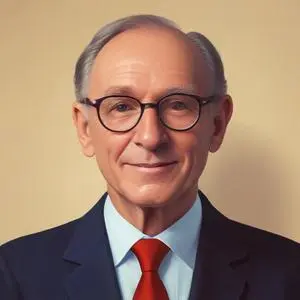
A Nobel Prize-winning physicist who pioneered research on superfluidity and quantum mechanics, making groundbreaking contributions to our understanding of matter at extremely low temperatures.
Sir Anthony James Leggett is a celebrated British-American theoretical physicist and professor emeritus at the University of Illinois Urbana-Champaign, renowned for his groundbreaking contributions to the understanding of low-temperature physics and superfluidity. His pioneering work in this field earned him the prestigious 2003 Nobel Prize in Physics, solidifying his position as a global authority in the realm of theoretical physics.
Born on March 26, 1938, in Camberwell, South London, Leggett was raised in a Catholic family with a strong educational background. His parents, both university-educated, instilled in him a passion for learning, which would eventually pave the way for his remarkable academic achievements.
Leggett's family has an intriguing history, with his father's forebears hailing from a small village in Hampshire, where they worked as village cobblers. His grandfather, however, broke with tradition to become a greengrocer. His mother's parents, of Irish descent, had an equally fascinating story, with her father working as a clerk in the naval dockyard in Chatham.
Leggett's academic career spanned several decades, during which he made significant contributions to the field of theoretical physics. Some of his most notable works include:
Leggett's work has far-reaching implications for various fields, including:
Leggett's remarkable contributions have been recognized with numerous awards and honors, including:
Leggett's work has also explored the foundations of quantum mechanics, sparking important discussions about the nature of reality and the role of consciousness. He has been an advocate for a more nuanced understanding of the quantum world, challenging traditional views and encouraging interdisciplinary approaches.
Leggett's personal life has been marked by significant milestones, including:
Sir Anthony James Leggett's pioneering work has left an indelible mark on the field of theoretical physics. His contributions continue to inspire new generations of scientists, fostering advancements in our understanding of the quantum world and its applications.
As a testament to his enduring legacy, Leggett's work remains a cornerstone of modern physics, shaping the course of research and innovation in the years to come.
86 Years Old
A Nobel Prize-winning physicist who discovered the Josephson effect, a phenomenon where a current flows between two superconductors separated by a thin insulator, leading to breakthroughs in quantum computing and electronics.
Born in 1908
Developed the transistor and pioneered superconductivity, revolutionizing modern electronics and earning two Nobel Prizes in Physics.
96 Years Old
A pioneer in superconductivity, he discovered the Cooper pair, a phenomenon where electrons team up to enable superconductivity, revolutionizing our understanding of materials and energy transmission.
76 Years Old
A Nobel Prize-winning physicist who discovered the fractional quantum Hall effect, a phenomenon where electrons behave as quasiparticles with unusual properties. His work has greatly advanced our understanding of quantum mechanics.
81 Years Old
A Nobel Prize-winning physicist who discovered superfluidity in helium-3, a breakthrough that has far-reaching implications for our understanding of quantum mechanics and the behavior of matter at extremely low temperatures.
95 Years Old
A Nobel Prize-winning physicist who discovered superfluidity in helium-3, a breakthrough that advanced our understanding of quantum mechanics and low-temperature physics.
Born in 1918
A brilliant physicist and engineer who pioneered quantum mechanics and famously explained complex concepts in simple terms, making science accessible to all.
97 Years Old
A pioneer in particle physics, discovering subatomic particles like quarks and gluons, and developing the theory of quantum chromodynamics.
