


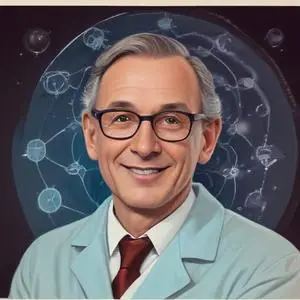
A Nobel Prize-winning physicist who discovered superfluidity in helium-3, a breakthrough that has far-reaching implications for our understanding of quantum mechanics and the behavior of matter at extremely low temperatures.
Douglas Osheroff, an American physicist, is renowned for his groundbreaking discovery of superfluidity in Helium-3, a phenomenon that has revolutionized the field of condensed matter physics. Together with David Lee and Robert C. Richardson, he was awarded the 1996 Nobel Prize in Physics for this pioneering work.
Born on August 1, 1945, in Aberdeen, Washington, Osheroff's eclectic heritage is a fascinating blend of Jewish and Slovak roots. His father, William Osheroff, was the son of Russian Jewish immigrants, while his mother, Bessie Anne Ondov, was the daughter of Slovak immigrants, with a Lutheran minister as her father.
Osheroff's educational journey began at Caltech, where he earned his bachelor's degree in 1967. During his time at Caltech, he was fortunate to attend lectures by the illustrious physicist Richard Feynman and conduct undergraduate research under the guidance of Gerry Neugebauer.
Osheroff's most significant contribution to science began when he joined the Laboratory of Atomic and Solid State Physics at Cornell University as a graduate student. Collaborating with David Lee and Robert C. Richardson, he utilized a Pomeranchuk cell to investigate the behavior of Helium-3 at temperatures mere thousandths of a degree away from absolute zero.
Their groundbreaking research led to the discovery of unexpected effects in their measurements, which they eventually explained as phase transitions to a superfluid phase of Helium-3. This pioneering work earned them the Nobel Prize in Physics in 1996.
Osheroff's philosophical outlook is deeply rooted in his experiences. He once stated, "In some sense, it seemed that lying in church is the worst place to lie. I guess at some emotional level I accept the idea of God, but I don't know how God would manifest itself."
This introspective perspective has influenced his approach to science, emphasizing the importance of honesty and authenticity in the pursuit of knowledge.
Douglas Osheroff's discovery of superfluidity has had a profound impact on the field of condensed matter physics. His work has paved the way for further research into the properties of helium isotopes and has opened doors to new areas of study, including superconductivity and quantum computing.
As a testament to his enduring legacy, Osheroff continues to inspire future generations of physicists, leaving an indelible mark on the scientific community.
Douglas Osheroff's remarkable journey is a testament to the power of human ingenuity and the importance of fundamental scientific research. His groundbreaking discovery of superfluidity has left an indelible mark on the world of physics, inspiring future generations of scientists to continue pushing the boundaries of human knowledge.
95 Years Old
A Nobel Prize-winning physicist who discovered superfluidity in helium-3, a breakthrough that advanced our understanding of quantum mechanics and low-temperature physics.
71 Years Old
Acclaimed cinematographer behind iconic films like "JFK" and "The Hateful Eight", known for his innovative camera techniques and gritty visual style.
68 Years Old
A German physicist and academic who won the Nobel Prize for his groundbreaking work on ultracold atoms and Bose-Einstein condensates, revolutionizing our understanding of quantum mechanics.
75 Years Old
A Nobel Prize-winning physicist who advanced our understanding of quantum mechanics and pioneered innovative teaching methods to improve science education. His work has transformed the way we learn and understand physics.
Born in 1908
Developed the transistor and pioneered superconductivity, revolutionizing modern electronics and earning two Nobel Prizes in Physics.
Born in 1922
A Nobel Prize-winning physicist and mathematician who discovered the muon neutrino, a subatomic particle, and made significant contributions to our understanding of the universe. His work has far-reaching implications for particle physics and beyond.
93 Years Old
Developed a unified theory of electromagnetism and the weak nuclear force, predicting the existence of neutral currents. This work led to a deeper understanding of subatomic particles and their interactions.
99 Years Old
Developed the first working laser, revolutionizing industries from medicine to telecommunications. This invention transformed the way we live, work, and communicate.
