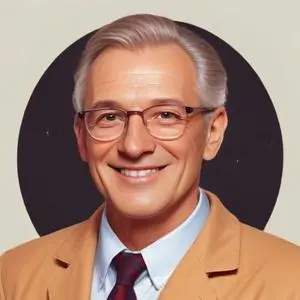
Wolfgang Ketterle: The Maestro of Ultracold Atoms
Achieving the Impossible: Bose-Einstein Condensation
Wolfgang Ketterle is renowned for being one of the pioneers in achieving Bose-Einstein condensation (BEC), a phenomenon where atoms are cooled to extremely low temperatures, near absolute zero, to form a single macroscopic wave function. This groundbreaking feat, accomplished in 1995, earned him the Nobel Prize in Physics in 2001, alongside
Eric Allin Cornell and Carl Wieman.
Early Life and Education
Born on October 21, 1957, in Heidelberg, Germany, Ketterle's fascination with physics began at a young age. He attended school in Eppelheim and Heidelberg before pursuing higher education at the University of Heidelberg. In 1978, he transferred to the Technical University of Munich, where he earned the equivalent of a master's diploma in 1982. Ketterle's Ph.D. research in experimental molecular spectroscopy, supervised by Herbert Walther and Hartmut Figger, was completed in 1986 at the
Max Planck Institute for Quantum Optics in Garching.
Career Highlights and Major Works
Ketterle's postdoctoral research at Garching and the University of Heidelberg laid the foundation for his future accomplishments. In 1990, he joined David E. Pritchard's group at the Research Laboratory of Electronics at MIT, where he was appointed to the physics faculty in 1993. As the John D. MacArthur Professor of Physics since 1998, Ketterle has led the Center for Ultracold Atoms at MIT.
- In 1997, Ketterle's group demonstrated interference between two colliding condensates, marking a significant milestone in the study of ultracold atoms.
- The creation of the first atom laser, the atomic analogue of an optical laser, was another remarkable achievement in 1997.
- In 2003, Ketterle's team successfully created a molecular Bose condensate, further expanding the understanding of ultracold phenomena.
- A 2005 experiment provided evidence for high-temperature superfluidity, yet another breakthrough in the realm of ultracold physics.
Philosophical Contributions and Beliefs
Ketterle's work has not only advanced our understanding of ultracold atoms but has also sparked discussions about the boundaries between quantum mechanics and classical physics. His research has led to a deeper understanding of the role of quantum fluctuations in macroscopic systems.
Influence on Modern Society
The applications of Ketterle's research are far-reaching, with potential implications for the development of more efficient sensors, better understanding of superconductors, and the creation of new materials with unusual properties. His work has inspired new generations of physicists and engineers, driving innovation in various fields.
Awards and Honors
In addition to the Nobel Prize in Physics in 2001, Ketterle has received numerous accolades, including the Rabi Prize, the
Benjamin Franklin Medal, and the Max Planck Medal.
Personal Milestones and Key Life Events
Ketterle's journey to achieving Bose-Einstein condensation was marked by perseverance and collaboration. His work has been shaped by his experiences as a postdoctoral researcher, a faculty member, and a director of research institutions.
Legacy and Impact on the Field
Wolfgang Ketterle's groundbreaking research has left an indelible mark on the field of physics. His work continues to inspire new research directions, driving the advancement of our understanding of the quantum world and its applications in modern society.
FAQ
What is Wolfgang Ketterles area of research?
Wolfgang Ketterle is a German physicist and academic who has made significant contributions to the field of ultracold atoms and quantum physics. He was awarded the Nobel Prize in Physics in 2001 for his work on Bose-Einstein condensation.
What is Bose-Einstein condensation?
Bose-Einstein condensation is a state of matter that occurs at extremely low temperatures, where a group of atoms or subatomic particles occupy the same quantum state. Wolfgang Ketterles work on this phenomenon has led to major advances in our understanding of quantum mechanics and its applications.
What is Wolfgang Ketterles approach to teaching and mentoring?
Wolfgang Ketterle is known for his commitment to teaching and mentoring the next generation of physicists. He has supervised numerous graduate students and postdoctoral researchers, and has developed innovative curricula and courses to promote hands-on learning and exploration.
What is Wolfgang Ketterles role in the scientific community?
Wolfgang Ketterle is a respected member of the scientific community, having served on various editorial boards, advisory committees, and research councils. He has also been involved in initiatives to promote science education and outreach, particularly in Germany and Europe.
What is Wolfgang Ketterles legacy in physics?
Wolfgang Ketterles work has had a profound impact on our understanding of quantum mechanics and its applications. His discovery of Bose-Einstein condensation has opened up new areas of research, and his contributions to the development of ultracold atom technology have paved the way for major breakthroughs in fields such as quantum computing and precision measurement.