


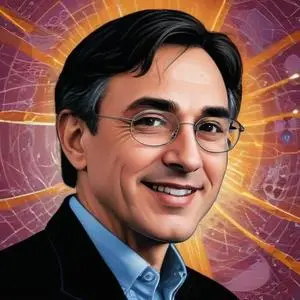
A Nobel Prize-winning physicist who advanced our understanding of quantum mechanics and pioneered innovative teaching methods to improve science education. His work has transformed the way we learn and understand physics.
Carl Wieman is a renowned American physicist and educationist, best known for producing the first true Bose-Einstein condensate (BEC) in 1995, a landmark achievement that earned him the Nobel Prize in Physics in 2001. This groundbreaking discovery, made in collaboration with Eric Allin Cornell, has had a profound impact on our understanding of quantum mechanics and its applications in various fields.
Wieman was born on March 26, 1951, in Corvallis, Oregon, to N. Orr Wieman and Alison Marjorie Fry. His paternal grandfather, Henry Nelson Wieman, was a religious philosopher of German descent, while his mother had a white Anglo-Saxon Protestant family background. Wieman's fascination with science began early, and he graduated from Corvallis High School before pursuing higher education.
Wieman earned his B.S. from the Massachusetts Institute of Technology (MIT) in 1973 and his Ph.D. from Stanford University in 1977. He was also awarded a Doctor of Science, honoris causa, from the University of Chicago in 1997.
Wieman's research has focused primarily on the study of ultracold atoms, particularly the creation of BECs. In 1995, he and Cornell produced the first true BEC, a state of matter that exists at extremely low temperatures, near absolute zero. This achievement has paved the way for numerous applications in fields such as quantum computing, precision measurements, and ultracold chemistry.
In addition to his research, Wieman has made significant contributions to science education. He is the founder of the PhET Interactive Simulations project, an open educational resource that provides interactive simulations for teaching science and math to students of all ages.
Wieman's work has been recognized with numerous awards and honors, including:
Wieman has held various teaching positions throughout his career, including:
Wieman's work has had a profound impact on our understanding of quantum mechanics and its applications. His contributions to science education have inspired a new generation of students and educators, promoting interactive and engaging learning experiences.
In a 2020 interview, Wieman reflected on his journey as a physicist, citing the influence of his parents and teachers on his trajectory and the importance of science education in shaping the future.
Today, Wieman continues to inspire and educate, leaving a lasting legacy in the fields of physics and education.
68 Years Old
A German physicist and academic who won the Nobel Prize for his groundbreaking work on ultracold atoms and Bose-Einstein condensates, revolutionizing our understanding of quantum mechanics.
81 Years Old
A Nobel Prize-winning physicist who discovered superfluidity in helium-3, a breakthrough that has far-reaching implications for our understanding of quantum mechanics and the behavior of matter at extremely low temperatures.
75 Years Old
A Nobel Prize-winning physicist who discovered the fractional quantum Hall effect, a phenomenon where electrons behave as quasiparticles with unusual properties. His work has greatly advanced our understanding of quantum mechanics.
78 Years Old
A Nobel Prize-winning physicist who served as the 12th United States Secretary of Energy, leading efforts to combat climate change and develop sustainable energy solutions. He's known for his groundbreaking research in laser cooling and trapping of atoms.
