


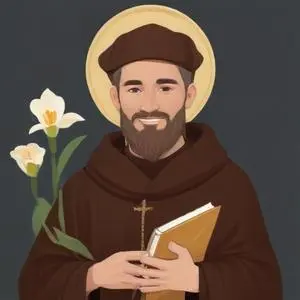
A 13th-century Franciscan priest and Doctor of the Church, known for his powerful preaching and miracles, especially finding lost items. He's the patron saint of lost things and travelers.
Known as the miracle worker and patron saint of lost things, Anthony of Padua is one of the most revered figures in Catholicism. With a lifelong devotion to the poor and the sick, Anthony's remarkable legacy has inspired countless generations of faithful followers.
Born Fernando Martins de Bulhes on August 15, 1195, in Lisbon, Portugal, Anthony was raised in a wealthy and noble family. Despite his privileged upbringing, Anthony was drawn to a life of spirituality and service, joining the Canons Regular of the Order of the Holy Cross at the age of 15.
At the Abbey of Saint Vincent on the outskirts of Lisbon, Anthony studied theology and Latin, honing his knowledge of scripture and developing a deep passion for scripture. In 1212, he transferred to the motherhouse of the congregation, the Monastery of the Holy Cross in Coimbra, where he continued his studies and deepened his commitment to the faith.
Ordained to the priesthood at the age of 19, Anthony was appointed guestmaster at the abbey, responsible for hospitality and welcoming visitors. However, it was during this time that he encountered the Friars Minor, a group of Franciscan friars who had settled at a small hermitage outside Coimbra. Inspired by their simplicity, humility, and devotion to the poor, Anthony joined the Franciscans, taking the name Anthony in honor of St. Anthony the Great.
Anthony's remarkable gift for preaching and his unwavering commitment to the poor and the sick earned him a reputation as a miracle worker. His powerful sermons and acts of kindness inspired countless conversions, and his ability to heal the sick and raise the dead solidified his status as a saint.
One of the most famous stories about Anthony is the miracle of the infant, in which he restored a stillborn child to life. This and other miracles, including the healing of a leper and the resurrection of a drowned child, cemented Anthony's reputation as a champion of the marginalized and downtrodden.
Anthony's legacy was cemented just a year after his death on June 13, 1231, when he was canonized a saint by Pope Gregory IX. This rapid canonization was a testament to Anthony's extraordinary impact on the Church and his remarkable devotion to the poor and the sick.
In 1946, Pope Pius XII declared Anthony a Doctor of the Church, recognizing his profound influence on Catholic theology and his contributions to the development of Catholic doctrine.
Anthony's words of wisdom and compassion continue to inspire and motivate people around the world. Among his most famous quotes are:
Anthony's legacy extends far beyond the realm of Catholicism. His emphasis on serving the poor and the marginalized has inspired countless social and charitable initiatives, and his commitment to education and intellectual pursuits has shaped the development of Catholic education and theology.
Today, Anthony remains a beloved and revered figure, celebrated as the patron saint of lost things, travelers, and pregnant women. His feast day, June 13, is celebrated around the world, and his remarkable legacy continues to inspire and motivate people of all faiths and backgrounds.
Born in 1491
Founded the Jesuit Order, a Catholic religious organization known for its missionary and educational work, and developed the Spiritual Exercises, a guide for spiritual growth and discernment.
Born in 1515
A 16th-century Spanish mystic and writer who introduced reforms to the Carmelite Order, promoting contemplative prayer and spiritual growth. Her writings are still widely read today.
Born in 1347
A 14th-century Italian mystic and Doctor of the Church, known for her intense spiritual experiences, influential writings, and advocacy for the poor and the unity of the Church.
