


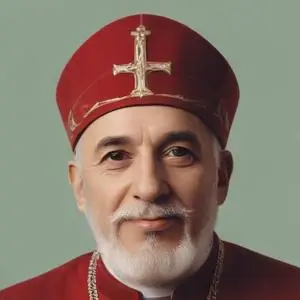
The leader of the Catholic Church from 1939 to 1958, known for his controversial role during World War II, particularly in regards to the Holocaust. He is also remembered for his encyclicals on social justice and liturgical reforms.
Pope Pius XII, born Eugenio Maria Giuseppe Giovanni Pacelli, reigned as the head of the Catholic Church and sovereign of the Vatican City State from 1939 until his death in 1958. He is perhaps best known for his leadership during World War II, a period marked by controversy and moral dilemmas that would shape his legacy forever.
Eugenio Pacelli was born on March 2, 1876, in Rome, Italy, to a family of minor nobility. He was ordained as a priest in 1899 and quickly rose through the ranks of the Vatican, serving as secretary of the Department of Extraordinary Ecclesiastical Affairs and papal nuncio to Germany.
As Cardinal Secretary of State, Pacelli played a crucial role in negotiating treaties with various European and Latin American nations, including the Reichskonkordat treaty with the German Reich. This treaty, signed in 1933, sought to protect the rights of the Catholic Church in Germany and marked the beginning of Pacelli's complex relationship with the Nazi regime.
As Pope Pius XII, Pacelli's leadership during World War II remains the subject of intense debate and controversy. While the Vatican officially maintained neutrality during the war, critics argue that Pius XII failed to publicly condemn the Nazi regime's atrocities, including the systematic persecution and genocide of six million Jews.
Defenders of Pius XII argue that he employed diplomacy to aid victims of the Nazis, directing the Church to provide discreet aid to Jews and others. This subtle approach, they claim, saved hundreds of thousands of lives. Critics, on the other hand, contend that Pius XII's silence was a moral failing, one that allowed the Nazi regime to commit heinous crimes with impunity.
Despite his public silence, Pius XII did engage in clandestine diplomacy to aid the victims of the Nazis. He maintained links to the German resistance and shared intelligence with the Allies, earning him the distrust of the Nazi regime.
In 1943, Pius XII's closest advisor, Father Robert Leiber, met secretly with the German resistance to discuss a plot to overthrow Hitler. This meeting, facilitated by the Vatican, demonstrates Pius XII's willingness to engage in covert diplomacy to undermine the Nazi regime.
Pope Pius XII issued 41 encyclicals during his papacy, addressing a range of topics from communism to liturgical reform. One of his most notable encyclicals, Mystici Corporis Christi, explored the Church as the Mystical Body of Christ.
In 1950, Pius XII issued the Apostolic constitution Munificentissimus Deus, invoking papal infallibility to proclaim the dogma of the Assumption of Mary. This decree, which asserted Mary's bodily assumption into heaven, marked a significant development in Catholic doctrine.
Pope Pius XII's legacy is fraught with controversy, his actions during World War II remaining the subject of intense debate. While some view him as a hero who saved countless lives through discreet diplomacy, others condemn him as a moral coward who failed to speak out against the Nazi regime.
Regardless of one's perspective, Pius XII's pontificate was marked by a complex web of moral dilemmas, diplomatic intrigue, and theological significance. His legacy continues to shape the Catholic Church, even as it sparks ongoing debate and controversy.
As the debate surrounding Pope Pius XII's legacy continues, one thing is certain: his pontificate will remain a subject of fascination and controversy for generations to come.
Born in 1920
Leader of the Catholic Church from 1978 to 2005, known for helping to end communism in Poland and being a charismatic advocate for human rights and social justice.
99 Years Old
The first pope to resign in nearly 600 years, he's known for his conservative views and efforts to strengthen the Catholic Church's traditional teachings. He's also a prolific writer and theologian.
89 Years Old
The leader of the Catholic Church, known for his progressive stance on social issues and efforts to reform the Church, inspiring millions worldwide.
Born in 1417
A 15th-century pope who played a significant role in the fall of the Western Schism, ending the division in the Catholic Church. He's also known for his lavish spending and nepotism.
Born in 1810
The first pope to fully embrace modernity, he issued the groundbreaking encyclical Rerum Novarum, which addressed social justice and workers' rights, shaping the Catholic Church's stance on social issues.
