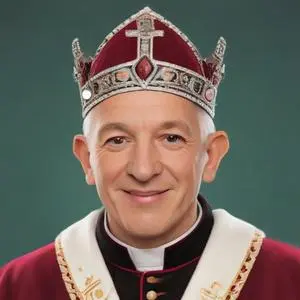
Pope Leo XIII: The Intellectual and Social Reformer
The Social Pope and His Lasting Legacy
Pope Leo XIII is renowned for his groundbreaking encyclical,
Rerum novarum, which outlined the rights of workers to a fair wage, safe working conditions, and the formation of trade unions, while affirming the rights to property and free enterprise. This pivotal document, issued in 1891, earned him the title of the "Social Pope" and the "Pope of the Workers," as he sought to define the position of the Catholic Church in relation to modern thinking.
Bio and Early Life
Born Gioacchino Vincenzo Raffaele Luigi Pecci on March 2, 1810, Pope Leo XIII was the sixth of seven children to Count Ludovico Pecci and Anna Prosperi Buzi. He was ordained as a priest in 1837 and quickly rose through the ranks, becoming the Bishop of Perugia in 1846. He was elevated to the cardinalate in 1853 and eventually became the Pope in 1878, serving until his death on July 20, 1903.
Philosophical Contributions and Beliefs
Pope Leo XIII was a staunch advocate for the revival of Thomism, the theological system of Thomas Aquinas. He believed that Thomism should be the official theological and philosophical foundation for the Catholic Church, and to this end, he sponsored the
Editio Leonina in 1879. This initiative aimed to promote the study and understanding of Aquinas' works, which had a profound impact on Catholic theology and philosophy.
Major Works and Encyclicals
In addition to
Rerum novarum, Pope Leo XIII issued a total of 86 encyclicals during his papacy, many of which addressed social and economic issues. Some notable encyclicals include:
- Aeterni Patris (1879), which promoted the study of Scholastic philosophy and theology.
- Diuturnum (1881), which addressed the nature of the Church and its relationship with the state.
- Immortale Dei (1885), which discussed the relationship between the Church and civil authority.
Influence on Modern Society
Pope Leo XIII's commitment to social reform and his advocacy for workers' rights have had a lasting impact on modern society. His encyclicals paved the way for the development of Catholic social teaching, influencing the thoughts and policies of his successors. His emphasis on the importance of pastoral activity in political sociology also helped to establish the Church as a vital force in promoting social justice and defending human dignity.
Personal Milestones and Key Life Events
- Living until the age of 93, Pope Leo XIII was the oldest pope whose age can be validated.
- He had the fourth-longest reign of any pope, behind St. Peter, Bl. Pius IX, and St. John Paul II.
- He was the first pope never to have held any control over the Papal States, which had been dissolved by 1870.
Legacy and Impact on the Catholic Church
Pope Leo XIII's intellectualism, social reform efforts, and commitment to defining the position of the Catholic Church in relation to modern thinking have left an indelible mark on the Church. His encyclicals and initiatives have shaped Catholic social teaching and continue to influence the Church's approach to social justice and human dignity. As a result, he is remembered as one of the most important and influential popes in Catholic history.
FAQ
What were Pope Leo XIIIs contributions to Catholicism?
Pope Leo XIII made significant contributions to Catholicism, issuing several influential encyclicals and promoting social justice and ecumenism.
How did Pope Leo XIIIs papacy impact the Catholic Church?
Pope Leo XIIIs papacy had a significant impact on the Catholic Church, marked by his efforts to promote social justice, ecumenism, and the development of Catholic social teaching.
What were Pope Leo XIIIs notable encyclicals?
Pope Leo XIIIs notable encyclicals include Rerum Novarum, which addressed the condition of the working class, and Aeterni Patris, which promoted the study of Thomistic philosophy.
How did Pope Leo XIIIs leadership impact the development of Catholic social teaching?
Pope Leo XIIIs leadership had a significant impact on the development of Catholic social teaching, which emphasizes the importance of social justice, human dignity, and the common good.
What was Pope Leo XIIIs legacy?
Pope Leo XIIIs legacy is that of a visionary pontiff who made significant contributions to Catholicism, promoting social justice, ecumenism, and the development of Catholic social teaching. His influence continues to shape Catholic thought and practice to this day.