


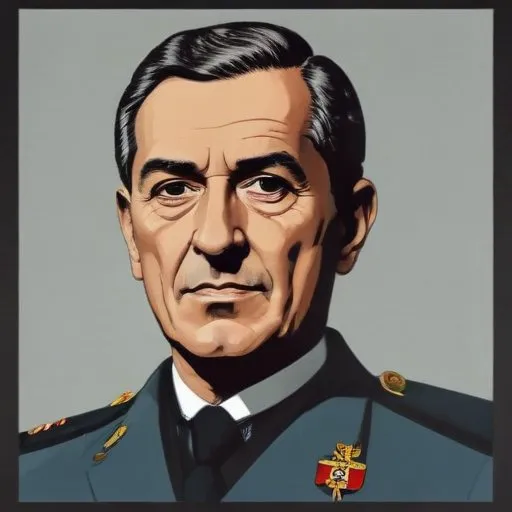
A Portuguese general and politician who served as the 16th President of Portugal, known for his key role in the country's transition to democracy after the Carnation Revolution. He's credited with stabilizing the country and promoting democratic reforms.
Antnio Ramalho Eanes is revered as the 16th President of Portugal, serving from 1976 to 1986, and is renowned for his instrumental role in transitioning the country from authoritarian rule to democracy. During his tenure, he implemented significant reforms, stabilizing the nation and paving the way for economic growth.
Born on January 25, 1935, in Alcains, Castelo Branco, Portugal, Eanes hails from a family of modest means. His father, Manuel dos Santos Eanes, was a general contractor, and his mother, Maria do Rosrio Ramalho, instilled in him the importance of education. Eanes's military career spanned over two decades, with active participation in the Portuguese Colonial Wars.
Stationed in Portuguese Angola during the 1974 Carnation Revolution, Eanes joined the Movement of the Armed Forces (MFA), a progressive organization seeking democratic reform. Upon returning to Portugal, he was appointed president of RTP, the Portuguese public television network. In 1975, he ordered military operations against the radical faction of the MFA, effectively ending the "Hot Summer" period of political unrest.
In 1976, Eanes was elected President of Portugal, committing to democratic principles and economic liberalization. He implemented measures to decentralize power, promote social welfare, and strengthen the country's international relationships. During his presidency, Portugal joined the European Economic Community (EEC), now the European Union.
After completing his second term as President, Eanes founded the Democratic Renewal Party (PRD) in 1985. Although he resigned as party leader in 1987, he continued to support the Social Democratic Party (PSD) minority government. Eanes has remained an influential figure in Portuguese politics, serving as a member of the Portuguese Council of State.
Eanes has received numerous accolades for his contributions to Portugal's democratization process, including:
Antnio Ramalho Eanes's presidency marked a pivotal moment in Portugal's history, as the country transitioned from authoritarian rule to a democratic system. His commitment to democratic principles, economic liberalization, and social welfare has had a lasting impact on Portuguese society, earning him a place as one of the most revered leaders in the country's history.
Eanes is known for his humility and simplicity, rejecting the title of Marshal, deeming it unnecessary. He remains a respected figure in Portuguese politics, dedicated to promoting democratic values and social progress.
Born in 1924
A Portuguese historian, lawyer, and politician who served as the 17th President of Portugal, known for leading the country's transition from authoritarianism to democracy. He played a key role in Portugal's decolonization and European integration.
77 Years Old
The first Portuguese to lead the United Nations, he's a champion of global cooperation, human rights, and sustainable development. He's a prominent voice on the world stage, advocating for climate action and social justice.
87 Years Old
The 19th President of the Portuguese Republic was a prominent economist and politician who served from 2006 to 2016, known for his economic reforms and leadership during the European sovereign-debt crisis. He is also a published author on economics and politics.
87 Years Old
The 18th President of Portugal, a lawyer and politician, served from 1996 to 2006 and was a key figure in the country's transition to democracy. He's known for his commitment to social justice and human rights.
