


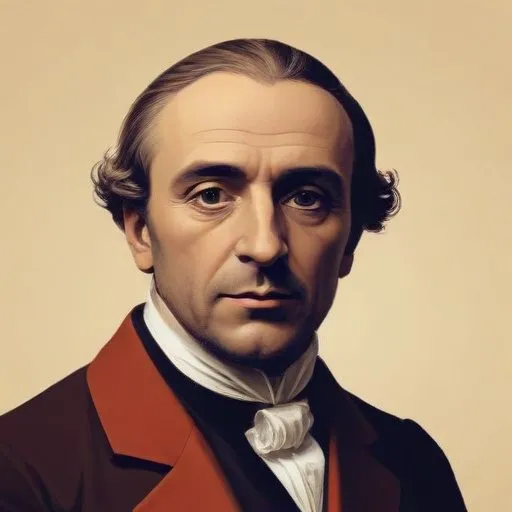
Developed mathematical theories and designed innovative engineering projects, including bridges and canals, in 18th-century France.
Antoine Deparcieux, a French mathematician born on October 28, 1703, is renowned for his groundbreaking work in probability theory, particularly his seminal essay, "Essai sur les probabilites de la dure de la vie humaine" (Essay on the probabilities of the human lifespan). This monumental work not only showcased his mastery of mathematical concepts but also shed light on the mysteries of human mortality, leaving an indelible mark on the field of statistics.
The son of a humble farmer, Deparcieux's early years were spent tending to the family farm in Clessous, France. However, his innate curiosity and thirst for knowledge soon led him to pursue a formal education at the school of Saint Florent, where he spent 10 years absorbing classical studies and developing a strong foundation in mathematics.
Besides his remarkable contributions to probability theory, Deparcieux was a master craftsman who manufactured sundials, a testament to his resourcefulness and practicality. His creations included:
Deparcieux's prolific writing career yielded several influential works, including:
Deparcieux's exceptional talent and dedication earned him numerous honors and memberships, including:
Antoine Deparcieux's pioneering work in probability theory has had a profound influence on the development of statistics, actuarial science, and Demography. His legacy continues to inspire and enlighten scholars, researchers, and mathematicians to this day, solidifying his position as a giant in the world of mathematics.
Born in 1749
Developed nebular hypothesis of the origin of the solar system and formulated Laplace's equation, a fundamental concept in mathematics and physics. He's considered the founder of celestial mechanics.
Born in 1736
Developed calculus, number theory, and celestial mechanics, making significant contributions to the fields of mathematics and astronomy.
Born in 1752
Developed the theory of elliptic integrals, and his work on number theory laid the foundation for modern cryptography.
Born in 1774
A French polymath who made significant contributions to the fields of physics, astronomy, and mathematics, particularly in the discovery of chromatic polarization and the Biot-Savart law.
Born in 1786
A mathematician and politician who made significant contributions to the development of electromagnetism and served as Prime Minister of France, advocating for social reform and education.
Born in 1777
A pioneer in mathematics and physics, he made major contributions to number theory, algebra, and electromagnetism, shaping our understanding of the natural world.
