


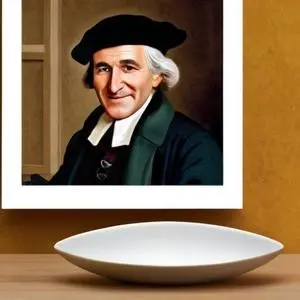
A pioneer in mathematics and physics, he made major contributions to number theory, algebra, and electromagnetism, shaping our understanding of the natural world.
Carl Friedrich Gauss, a German mathematician, astronomer, and physicist, is renowned for his profound contributions to various fields, earning him the title "the Prince of Mathematicians." His work has had a lasting impact on mathematics, science, and astronomy, cementing his position as one of the most influential minds in history.
Gauss was born on April 30, 1777, in Braunschweig, Germany, to a poor but intellectually inclined family. His exceptional math skills were evident from an early age, and he began attending the University of Göttingen in 1795. It was during this period that he propounded several mathematical theorems, laying the foundation for his future accomplishments.
Gauss's magnum opus, Disquisitiones Arithmeticae, published in 1801, is considered one of the most influential works in the history of mathematics. In it, he presented his groundbreaking theories on number theory, binary and ternary quadratic forms, and the fundamental theorem of algebra. He also made significant contributions to non-Euclidean geometry, alongside Nikolai Lobachevsky and János Bolyai, and coined the term "non-Euclidean geometry."
Gauss's work in astronomy was equally impressive. He was instrumental in the identification of Ceres as a dwarf planet and developed methods for determining the orbits of celestial bodies. His research on the motion of planetoids led to the introduction of the Gaussian gravitational constant and the method of least squares, which he had discovered before Adrien-Marie Legendre published it.
In the field of geodesy, Gauss was in charge of the extensive survey of the Kingdom of Hanover, which led to the development of the fundamental principles of magnetism. He also invented the heliotrope in 1821 and, alongside Wilhelm Eduard Weber, the first electromagnetic telegraph in 1833.
Although Gauss confessed to disliking teaching, he had a profound impact on his students, many of whom went on to become influential mathematicians. He believed that the act of learning, not possession of knowledge, provided the greatest enjoyment. Gauss refused to publish incomplete work, leaving several works to be edited posthumously.
Gauss was known for his humility and simplicity, despite his exceptional genius. He remained in his professorship at the University of Göttingen until his death in 1855, and his legacy continues to inspire mathematicians and scientists to this day.
Gauss was awarded the Copley Medal in 1838 by the Royal Society for his outstanding contributions to mathematics and science.
Gauss's work has had a profound impact on modern society, influencing fields such as physics, engineering, and computer science. His legacy continues to inspire new generations of mathematicians and scientists, solidifying his position as one of the most important figures in the history of science.
Born in 1707
Pioneering mathematician and physicist who made immense contributions to fields like calculus, number theory, and optics, shaping the course of modern mathematics and physics.
Born in 1749
Developed nebular hypothesis of the origin of the solar system and formulated Laplace's equation, a fundamental concept in mathematics and physics. He's considered the founder of celestial mechanics.
Born in 1752
Developed the theory of elliptic integrals, and his work on number theory laid the foundation for modern cryptography.
Born in 1826
A pioneering mathematician who developed the theory of higher dimensions and laid the foundations for modern physics, particularly in the understanding of space and time.
Born in 1862
A renowned mathematician and academic who developed infinite-dimensional vector spaces and laid the foundation for quantum mechanics and relativity. He's also famous for his 23 unsolved math problems that shaped 20th-century mathematics.
Born in 1882
A pioneering mathematician and physicist who revolutionized abstract algebra and made groundbreaking contributions to modern physics, particularly in the development of Einstein's theory of general relativity.
73 Years Old
Proved Fermat's Last Theorem, a problem that went unsolved for over 350 years, and made significant contributions to number theory. His work has far-reaching implications for mathematics and cryptography.
