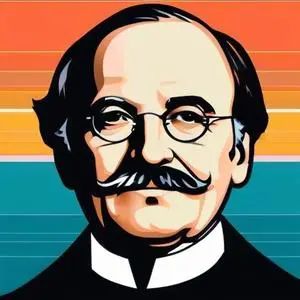
Bernhard Riemann: The Visionary Mathematician
A Legacy of Pioneering Contributions
Bernhard Riemann, a German mathematician, is renowned for his groundbreaking work in analysis, number theory, and differential geometry. His seminal contributions have had a profound impact on the development of modern mathematics, earning him a reputation as one of the greatest mathematicians of all time.
Early Life and Education
Riemann was born on September 17, 1826, in Breselenz, a small village near Dannenberg in the Kingdom of Hanover. His father, Friedrich Bernhard Riemann, was a poor Lutheran pastor who fought in the Napoleonic Wars. Riemann's mother, Charlotte Ebell, passed away in 1846. As the second of six children, Riemann exhibited exceptional mathematical talent from an early age, but struggled with timidity and a fear of speaking in public.
Mathematical Breakthroughs
Riemann's most notable contributions include:
- The Riemann Integral: He introduced the first rigorous formulation of the integral, which revolutionized the field of real analysis.
- Riemann Surfaces: His work on complex analysis led to the development of Riemann surfaces, providing a natural, geometric treatment of complex functions.
- The Riemann Hypothesis: His 1859 paper on the prime counting function contains the original statement of the Riemann hypothesis, a foundational concept in analytic number theory.
- Differential Geometry: Riemann's pioneering contributions to differential geometry laid the foundations for the mathematics of general relativity.
Influence on Modern Society
Riemann's work has had a profound impact on various fields, including:
- Physics: His contributions to differential geometry paved the way for the development of general relativity and modern astrophysics.
- Computer Science: The Riemann integral and Riemann surfaces have applications in computer graphics, visualization, and scientific computing.
- Cryptography: The Riemann hypothesis has implications for number theory and cryptography, influencing the development of secure communication systems.
Personal Life and Milestones
Riemann's life was marked by personal struggles, including:
- Nervous Breakdowns: He suffered from numerous nervous breakdowns throughout his life, often hindering his academic progress.
- Shyness and Timidity: Riemann's fear of speaking in public made it challenging for him to present his work and receive recognition.
- : Riemann passed away on July 20, 1866, at the age of 39, due to complications from tuberculosis.
Legacy and Impact
Riemann's legacy extends far beyond his mathematical contributions. He inspired generations of mathematicians, including
David Hilbert, Henri Poincaré, and
John von Neumann, who built upon his work. Today, Riemann's ideas continue to influence fields as diverse as physics, computer science, and cryptography, cementing his status as one of the greatest mathematicians of all time.
Quotes and Memorable Sayings
* "If only I had the theorem of Fermat, I would give all my theorems in exchange." - Bernhard Riemann
* "The mathematician's patterns, like the painter's, must be beautiful; the ideas, like the colours, must fit together in a harmonious way." - Bernhard Riemann
FAQ
What is Bernhard Riemanns most famous contribution to mathematics?
Bernhard Riemanns most famous contribution to mathematics is his development of the theory of manifolds, which laid the foundations for modern differential geometry and topology.
What was Bernhard Riemanns early education like?
Bernhard Riemann was largely self-taught in mathematics, despite studying theology at the University of Göttingen. He later switched to mathematics and was mentored by Carl Friedrich Gauss.
What was Bernhard Riemanns work on the hypothesis of prime numbers?
Bernhard Riemanns work on the hypothesis of prime numbers led to the development of the Riemann Hypothesis, one of the most famous unsolved problems in mathematics.
How did Bernhard Riemanns work influence Albert Einstein?
Bernhard Riemanns work on differential geometry and curvature of space-time heavily influenced Albert Einsteins development of general relativity.
What legacy did Bernhard Riemann leave behind?
Bernhard Riemanns legacy is that of a mathematical genius who laid the foundations for many areas of modern mathematics and physics. His work continues to influence mathematicians and physicists around the world.