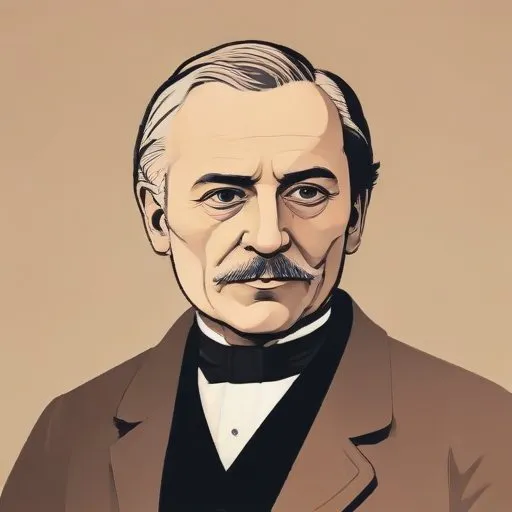
Wilhelm Eduard Weber: The Pioneer of Electromagnetic Telegraphy
The Invention that Changed the Course of Communication
Wilhelm Eduard Weber, a German physicist, is renowned for his groundbreaking invention of the first electromagnetic telegraph, a revolutionary innovation that transformed the way people communicate. Alongside
Carl Friedrich Gauss, Weber's invention paved the way for the development of modern telecommunication systems.
Early Life and Education
Born on October 24, 1804, in Schlossstrasse, Wittenberg, Germany, Weber was the second of three brothers, all of whom were gifted in science. His father, Michael Weber, a professor of theology, played a significant role in nurturing Wilhelm's curiosity and love for science. After the dissolution of the University of Wittenberg, his father was transferred to Halle in 1815, where Wilhelm received his early education at the Orphan Asylum and Grammar School.
Career Highlights and Major Works
Weber's academic excellence earned him a degree of Doctor and a position as a Privatdozent at the University of Halle. In 1831, Carl Friedrich Gauss recommended him as a professor of physics at the University of Göttingen, where he began his illustrious career at the age of twenty-seven. Weber's lectures were engaging, informative, and thought-provoking, encouraging his students to experiment and explore the world of physics.
The Wave Theory and Fluidity
In collaboration with his brother,
Ernst Heinrich Weber, a professor of anatomy at Leipzig, Wilhelm wrote a seminal book on the Wave Theory and Fluidity, which garnered widespread recognition and acclaim.
Acoustics and the Mechanism of Walking
Weber's fascination with acoustics led him to publish numerous papers in esteemed journals such as Poggendorff's Annalen, Schweigger's Jahrbücher für Chemie und Physik, and the musical journal Cäcilia. His studies on the mechanism of walking in humans, undertaken with his brother, further showcased his versatility and depth of knowledge.
Philosophical Contributions and Beliefs
Weber's approach to science was centered on the idea that theoretical knowledge must be grounded in practical experimentation. He believed that students should be encouraged to explore and experiment with scientific concepts, rather than merely relying on lectures and textbooks.
Influence on Modern Society
The invention of the electromagnetic telegraph had far-reaching consequences for global communication, facilitating the transmission of information across vast distances. Weber's legacy extends beyond his invention, as his emphasis on practical experimentation and hands-on learning has inspired generations of scientists and educators.
Personal Milestones and Key Life Events
- 1804: Born in Schlossstrasse, Wittenberg, Germany
- 1815: Father transferred to Halle, where Wilhelm received his early education
- 1831: Became professor of physics at the University of Göttingen
- 1891: Passed away on June 23, leaving behind a lasting legacy in the world of science
Legacy and Historical Context
Weber's contributions to the development of electromagnetic telegraphy have cemented his place in the annals of scientific history. His innovative approach to education and his emphasis on practical experimentation have inspired countless scientists, educators, and thinkers. As a pioneer in the field of physics, Wilhelm Eduard Weber's legacy continues to shape our understanding of the world and the way we communicate.
FAQ
What were Wilhelm Eduard Webers contributions to physics?
Wilhelm Eduard Weber was a German physicist, who made significant contributions to the development of electromagnetic theory, and was one of the founders of the science of electrical engineering.
How did Wilhelm Eduard Weber influence the development of electrical engineering?
Webers work on electromagnetic theory and his development of the concept of electromagnetic induction paved the way for the development of electrical engineering, and his research laid the foundation for many later technological innovations.
What was Wilhelm Eduard Webers role in the development of the Weber-Fechner law?
Weber, along with Gustav Theodor Fechner, developed the Weber-Fechner law, which describes the relationship between the intensity of a stimulus and the perceived magnitude of the sensation.
How did Wilhelm Eduard Weber contribute to the development of German science?
Weber was a prominent figure in German science, and his work helped to establish Germany as a center of scientific research, particularly in the fields of physics and electrical engineering.
Why is Wilhelm Eduard Weber an important figure in the history of physics?
Weber is an important figure in the history of physics due to his significant contributions to electromagnetic theory, his influence on the development of electrical engineering, and his role in shaping the course of German science.