


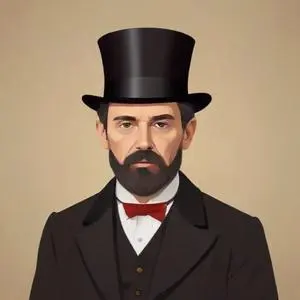
Developed the theory of thermodynamics, introducing the concept of entropy, and made significant contributions to the fields of electricity and magnetism.
Rudolf Clausius, a German physicist and mathematician, is renowned for laying the foundation of the science of thermodynamics. His groundbreaking work, particularly his restatement of Sadi Carnot's principle, known as the Carnot cycle, provided a truer and sounder basis for the theory of heat.
Clausius was born on January 2, 1822, in Koszalin, Poland (then part of Prussia), to a Protestant pastor and school inspector. He studied in his father's school and later attended the Gymnasium in Stettin. Clausius graduated from the University of Berlin in 1844, where he had studied mathematics and physics under prominent scholars such as Gustav Magnus, Peter Gustav Lejeune Dirichlet, and Jakob Steiner.
In 1850, Clausius published his most important paper, "On the Moving Force of Heat," which introduced the concept of the second law of thermodynamics. This seminal work revolutionized the understanding of heat and its relationship with energy. In 1865, he introduced the concept of entropy, a measure of the disorder or randomness of a system.
Clausius's work had a significant impact on the development of thermodynamics. He organized his ideas into a systematic theory, providing a framework for understanding the behavior of heat and energy. His work also led to the development of the virial theorem, which relates the average kinetic energy of molecules in a system to the pressure of the system.
Clausius held professorships at various institutions, including the Royal Artillery and Engineering School in Berlin, the ETH Zürich, and the University of Würzburg. He was known for his dedication to teaching and was awarded the Iron Cross for his services during the Franco-Prussian War.
In his personal life, Clausius faced challenges, including the death of his first wife, Adelheid Rimpau, in 1875, and a lasting disability from a battle wound. He remarried in 1886 and had another child. Clausius passed away on August 24, 1888, in Bonn, Germany.
Rudolf Clausius's contributions to thermodynamics are immeasurable. His work laid the foundation for the development of modern physics, chemistry, and engineering. His concept of entropy has far-reaching implications in fields beyond thermodynamics, including philosophy, biology, and ecology.
Rudolf Clausius's legacy continues to inspire scientists, engineers, and thinkers across disciplines, solidifying his place as one of the most important figures in the history of science.
Born in 1821
A 19th-century physician and physicist who made significant contributions to the fields of electromagnetism, thermodynamics, and the physiology of human perception, particularly in the study of vision and hearing.
Born in 1844
Developed the theory of statistical mechanics, which explains the behavior of gases and is a fundamental concept in modern physics.
Born in 1858
A pioneer in quantum theory, he introduced the concept of the Planck constant, revolutionizing our understanding of energy and matter.
Born in 1879
A brilliant physicist who developed the theory of relativity and is considered one of the most influential scientists of the 20th century, known for his groundbreaking work in physics and mathematics.
