


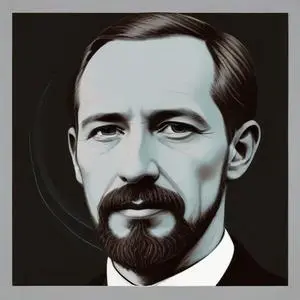
A pioneer in the field of electromagnetism, he discovered radio waves and proved James Clerk Maxwell's theories, paving the way for modern wireless communication. His experiments led to the development of radio, television, and mobile phones.
Heinrich Hertz, a German physicist, etched his name in the annals of history by conclusively proving the existence of electromagnetic waves, predicted by James Clerk Maxwell's equations of electromagnetism. This groundbreaking discovery earned him the distinction of having the unit of frequency, cycle per second, named after him - the hertz.
Born on February 22, 1857, in Hamburg, Germany, Hertz hailed from a prosperous and cultured Hanseatic family. His father, Gustav Ferdinand Hertz, and mother, Anna Elisabeth Pfefferkorn, instilled in him a passion for sciences and languages. He demonstrated an aptitude for both, learning Arabic during his time at the Gelehrtenschule des Johanneums in Hamburg.
Hertz's educational journey took him to various German cities, including Dresden, Munich, and Berlin, where he studied sciences and engineering under the tutelage of renowned scholars Gustav R. Kirchhoff and Hermann von Helmholtz. He earned his PhD from the University of Berlin in 1880 and spent the next three years as Helmholtz's assistant, further honing his skills.
In 1883, Hertz took up a position as a lecturer in theoretical physics at the University of Kiel, before becoming a full professor at the University of Karlsruhe in 1885. It was during this period that he conducted his pioneering research into electromagnetic waves, which led to the discovery of radio waves.
Hertz's work in this field was nothing short of revolutionary, as he successfully demonstrated the existence of electromagnetic waves using a series of experiments involving oscillating electric currents, sparking coils, and wirelessly transmitted signals. This discovery paved the way for the development of modern radio communication and wireless technology.
In 1886, Hertz married Elisabeth Doll, daughter of Max Doll, a lecturer in geometry at Karlsruhe. The couple had two daughters, Johanna and Mathilde, the latter of whom went on to become a notable biologist.
Hertz's contributions to science were not limited to his work on electromagnetic waves. He also made significant contributions to the field of theoretical mechanics, publishing his work, Die Prinzipien der Mechanik in neuem Zusammenhange dargestellt (The Principles of Mechanics Presented in a New Form), posthumously in 1894.
Tragically, Hertz's life was cut short when he succumbed to an infection in 1892, at the age of 36. His untimely death robbed the scientific community of a brilliant mind, but his legacy lives on, inspiring generations of scientists and engineers.
Hertz's discovery of radio waves has had a profound impact on modern society, enabling the development of wireless communication systems, radio broadcasting, and countless other technologies that rely on electromagnetic waves.
Awards and honors have been bestowed upon Hertz in recognition of his contributions, including the naming of the unit of frequency, the hertz, in his honor. His work continues to inspire scientific inquiry and innovation, cementing his place as one of the most influential scientists of the 19th century.
Born in 1831
Developed groundbreaking theories that unified electricity and magnetism, and predicted the existence of radio waves, revolutionizing our understanding of the physical world.
Born in 1791
Pioneering scientist who discovered electromagnetic induction, formulated the laws of electrolysis, and invented the first electrical generator, revolutionizing our understanding of electricity and its applications.
Born in 1879
A brilliant physicist who developed the theory of relativity and is considered one of the most influential scientists of the 20th century, known for his groundbreaking work in physics and mathematics.
Born in 1856
A pioneering engineer who harnessed the power of alternating current (AC) to transform the world's electrical systems, and is credited with developing groundbreaking technologies like radio communication and X-ray imaging.
Born in 1874
Developer of the first practical wireless telegraph, pioneering radio communication and earning a Nobel Prize in Physics. Known for revolutionizing long-distance communication.
Born in 1851
Developed key theories on electromagnetic radiation and invented the first wireless telegraph, paving the way for modern communication systems.
Born in 1821
A 19th-century physician and physicist who made significant contributions to the fields of electromagnetism, thermodynamics, and the physiology of human perception, particularly in the study of vision and hearing.
Born in 1804
Developed the first electromagnetic theory of light and made significant contributions to the understanding of electricity and magnetism. He's also credited with inventing the first electromagnetic telegraph.
