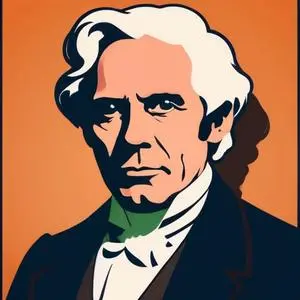
Michael Faraday

Michael Faraday

Michael Faraday was born on September 22nd, 1791

Full Name: Michael Faraday
Profession: Physicist, Chemist
Nationality: English
Birth Year: 1791
Death Year: 1867
Place of Birth: Newington Butts, England
Notable Discovery: Electromagnetic induction
Notable Field: Electromagnetism

Pioneering scientist who discovered electromagnetic induction, formulated the laws of electrolysis, and invented the first electrical generator, revolutionizing our understanding of electricity and its applications.

Timeline
1791
Born in Newington Butts
Michael Faraday was born on September 22, 1791, in Newington Butts, England, to a family of blacksmiths.
1813
Became Laboratory Assistant
Faraday became a laboratory assistant to Sir Humphry Davy at the Royal Institution, where he would go on to make groundbreaking discoveries in the field of chemistry.
1831
Discovered Electromagnetic Induction
Faraday discovered electromagnetic induction, a fundamental principle of physics that would revolutionize the field of electrical engineering.
1857
Became Director of the Royal Institution
Faraday became the director of the Royal Institution, serving in the position until his retirement in 1861.
1867
Died in Hampton Court
Michael Faraday passed away on August 25, 1867, in Hampton Court, leaving behind a legacy as one of the most influential scientists of the 19th century.
Michael Faraday

Michael Faraday Quiz

What is the fundamental principle behind Michael Faraday's discovery of electromagnetic induction?

Score: 0/5
FAQ
What is Michael Faradays most famous discovery?
Michael Faradays most famous discovery is the principle of electromagnetic induction, which describes how a changing magnetic field induces an electric field. This discovery revolutionized our understanding of electricity and magnetism.
What is the significance of Michael Faradays laws of electrolysis?
Michael Faradays laws of electrolysis describe the chemical reactions that occur during electrolysis, providing a fundamental understanding of the relationship between electricity and chemistry. These laws have far-reaching implications for fields such as electrochemistry and electrometallurgy.
What is the Faraday effect?
The Faraday effect is a phenomenon discovered by Michael Faraday, where the plane of polarization of light is rotated when it passes through a magnetic field. This effect is a fundamental aspect of electromagnetic theory.
How did Michael Faradays experiments on electrical conduction challenge prevailing theories?
Michael Faradays experiments on electrical conduction challenged the prevailing theories of the time, which held that electricity was a fluid-like substance. His work demonstrated that electricity is a fundamental property of matter, paving the way for modern electromagnetism.
What was Michael Faradays approach to scientific inquiry?
Michael Faradays approach to scientific inquiry was characterized by meticulous experimentation, careful observation, and a willingness to challenge prevailing theories. He believed in the importance of experimentation and empirical evidence in scientific discovery.

Related People:

Humphry Davy

Born in 1778

Pioneering chemist and physicist who discovered several elements, including potassium and sodium, and invented the Davy lamp, a safety lamp for miners. His groundbreaking work laid the foundation for modern chemistry and electrochemistry.

James Clerk Maxwell

Born in 1831

Developed groundbreaking theories that unified electricity and magnetism, and predicted the existence of radio waves, revolutionizing our understanding of the physical world.

Antoine Lavoisier

Born in 1743

Father of modern chemistry, discovered oxygen, and developed a systematic method of chemical nomenclature. He laid the foundation for modern chemistry and paved the way for future scientific discoveries.

Alessandro Volta

Born in 1745

Italian physicist who invented the first electrical battery, revolutionizing the field of electricity and paving the way for countless technological advancements.

Carl Friedrich Gauss

Born in 1777

A pioneer in mathematics and physics, he made major contributions to number theory, algebra, and electromagnetism, shaping our understanding of the natural world.

André-Marie Ampère

Born in 1775

A pioneer in the field of electromagnetism, he formulated fundamental laws that describe the relationship between electric currents and magnetic fields. His work laid the foundation for many modern technologies, including electric motors and generators.

Georg Ohm

Born in 1789

Formulated laws governing the relationship between voltage, current, and resistance in electric circuits, revolutionizing the field of electrical engineering.

Heinrich Hertz

Born in 1857

A pioneer in the field of electromagnetism, he discovered radio waves and proved James Clerk Maxwell's theories, paving the way for modern wireless communication. His experiments led to the development of radio, television, and mobile phones.