


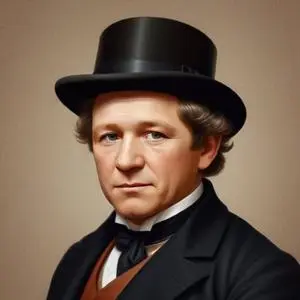
Formulated laws governing the relationship between voltage, current, and resistance in electric circuits, revolutionizing the field of electrical engineering.
Imagine a world without electricity, where bulbs don't glow, and motors don't hum. Georg Ohm, a German physicist and mathematician, changed the game by discovering the fundamental relationship between voltage, current, and resistance. His groundbreaking work led to the development of Ohm's Law, a concept that revolutionized the field of electrical engineering.
Georg Simon Ohm was born on March 16, 1789, in Erlangen, Brandenburg-Bayreuth, then part of the Holy Roman Empire. His father, Johann Wolfgang Ohm, a skilled locksmith, recognized the importance of education and taught Georg and his younger brother Martin mathematics, physics, chemistry, and philosophy from an early age. This strong foundation laid the groundwork for Ohm's future success.
In the early 19th century, Ohm began researching the newly invented electrochemical cell by Alessandro Volta. Using his own equipment, he experimented with the relationship between voltage and current, leading to the discovery of Ohm's Law. This fundamental concept states that the voltage applied across a conductor is directly proportional to the resulting electric current.
Ohm's Law paved the way for the development of modern electrical systems. His work influenced the design of electrical circuits, motors, and generators, transforming industries such as transportation, communication, and manufacturing.
In recognition of his contributions, the unit of electrical resistance, the ohm (Ω), was named after Georg Ohm. He was also honored with the Copley Medal in 1841 for his outstanding work in physics.
Ohm's passion for learning and teaching inspired his students, and his brother Martin, who became a renowned mathematician. His dedication to his work and family left a lasting impact on the scientific community.
Georg Ohm's legacy extends beyond his groundbreaking discovery, inspiring generations of scientists, engineers, and innovators to build upon his foundation. His work continues to illuminate our world, powering our daily lives and shaping the future.
Born in 1745
Italian physicist who invented the first electrical battery, revolutionizing the field of electricity and paving the way for countless technological advancements.
Born in 1791
Pioneering scientist who discovered electromagnetic induction, formulated the laws of electrolysis, and invented the first electrical generator, revolutionizing our understanding of electricity and its applications.
Born in 1831
Developed groundbreaking theories that unified electricity and magnetism, and predicted the existence of radio waves, revolutionizing our understanding of the physical world.
Born in 1857
A pioneer in the field of electromagnetism, he discovered radio waves and proved James Clerk Maxwell's theories, paving the way for modern wireless communication. His experiments led to the development of radio, television, and mobile phones.
Born in 1856
A pioneering engineer who harnessed the power of alternating current (AC) to transform the world's electrical systems, and is credited with developing groundbreaking technologies like radio communication and X-ray imaging.
Born in 1775
A pioneer in the field of electromagnetism, he formulated fundamental laws that describe the relationship between electric currents and magnetic fields. His work laid the foundation for many modern technologies, including electric motors and generators.
Born in 1777
A pioneer in mathematics and physics, he made major contributions to number theory, algebra, and electromagnetism, shaping our understanding of the natural world.
Born in 1821
A 19th-century physician and physicist who made significant contributions to the fields of electromagnetism, thermodynamics, and the physiology of human perception, particularly in the study of vision and hearing.
