


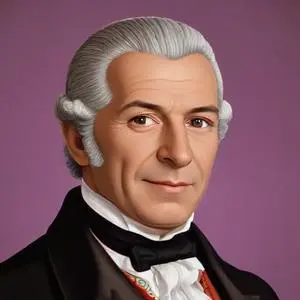
Italian physicist who invented the first electrical battery, revolutionizing the field of electricity and paving the way for countless technological advancements.
Alessandro Volta is renowned for inventing the electric battery and discovering methane, revolutionizing the field of electricity and power. His groundbreaking invention, the voltaic pile, proved that electricity could be generated chemically, debunking the prevailing theory that it was solely produced by living beings.
Born on February 18, 1745, in Como, Italy, Volta was the son of Filippo Volta, a nobleman, and Donna Maddalena Inzaghi. He was raised in a family that valued education, which led him to pursue a career in science.
Volta's academic career began in 1774 when he became a professor of physics at the Royal School in Como. He later held the chair of experimental physics at the University of Pavia for nearly 40 years, earning him widespread recognition and admiration from his students.
In 1799, Volta invented the voltaic pile, a device composed of alternating layers of zinc and copper discs separated by cardboard soaked in saltwater. This invention sparked a tremendous amount of scientific excitement, leading others to conduct similar experiments and eventually develop the field of electrochemistry.
Volta's discovery had a profound impact on modern society. The invention of the electric battery paved the way for the development of electrical systems, transforming the way people live, work, and communicate.
The SI unit of electric potential, the volt, was named in his honor, recognizing his significant contribution to the field of electricity.
In 1794, Volta married Teresa Peregrini, an aristocratic lady from Como, with whom he had three sons: Zanino, Flaminio, and Luigi. Despite his professional success, Volta preferred a secluded life, devoting more time to his family, especially in his later years.
Volta's invention earned him admiration from Napoleon Bonaparte, who conferred upon him numerous honors. He was invited to the Institute of France to demonstrate his invention to the members of the institute, solidifying his reputation as a pioneer in the field of electricity.
Alessandro Volta's pioneering work in electricity and power has left an indelible mark on the scientific community. His invention of the electric battery and discovery of methane continue to inspire scientific innovation, shaping the modern world as we know it.
Volta's legacy extends beyond his scientific contributions. He remains an inspiration to generations of scientists, engineers, and innovators, symbolizing the power of human ingenuity and the importance of pursuing knowledge and discovery.
Born in 1706
A founding father of the United States, he was a leading figure in the Enlightenment, known for his groundbreaking inventions, scientific discoveries, and influential writings. He played a key role in shaping American history and politics.
Born in 1737
Pioneering researcher who discovered bioelectricity, sparking a new understanding of the human body and paving the way for modern medical advancements.
Born in 1791
Pioneering scientist who discovered electromagnetic induction, formulated the laws of electrolysis, and invented the first electrical generator, revolutionizing our understanding of electricity and its applications.
Born in 1831
Developed groundbreaking theories that unified electricity and magnetism, and predicted the existence of radio waves, revolutionizing our understanding of the physical world.
Born in 1821
A 19th-century physician and physicist who made significant contributions to the fields of electromagnetism, thermodynamics, and the physiology of human perception, particularly in the study of vision and hearing.
Born in 1775
A pioneer in the field of electromagnetism, he formulated fundamental laws that describe the relationship between electric currents and magnetic fields. His work laid the foundation for many modern technologies, including electric motors and generators.
Born in 1789
Formulated laws governing the relationship between voltage, current, and resistance in electric circuits, revolutionizing the field of electrical engineering.
Born in 1804
Developed the first electromagnetic theory of light and made significant contributions to the understanding of electricity and magnetism. He's also credited with inventing the first electromagnetic telegraph.
