


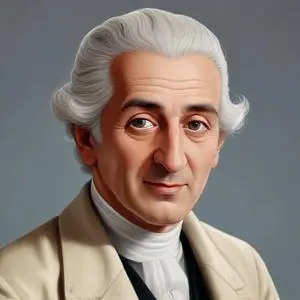
Pioneering researcher who discovered bioelectricity, sparking a new understanding of the human body and paving the way for modern medical advancements.
Luigi Galvani, an 18th-century Italian physician, physicist, biologist, and philosopher, is renowned for his groundbreaking discovery of bioelectricity in animals. His pioneering work in animal electricity paved the way for significant advancements in the fields of physiology, neuroscience, and medical electricity.
Born on September 9, 1737, in Bologna, Italy, Galvani descended from a family of goldsmiths. His father, Domenico Galvani, was a skilled craftsman who instilled in his son a passion for learning. Galvani's educational pursuits led him to study medicine at the University of Bologna, where he earned his degree in 1759.
In 1780, Galvani conducted a series of experiments that would change the course of scientific history. He observed that the muscles of dead frogs' legs twitched when struck by an electrical spark, leading him to conjecture that animals possessed an inherent electric fluid. This discovery marked the beginning of bioelectricity as a field of study.
Alessandro Volta, a prominent physicist and professor at the University of Pavia, was among the first to replicate and scrutinize Galvani's experiments. Although Volta initially supported Galvani's findings, he eventually disputed the existence of an animal electric fluid. The disagreement between the two scientists sparked a heated debate, with Volta proposing that the contractions were caused by the metal cable used in the experiments rather than any intrinsic electrical property of the animals. Despite their disagreements, the two scientists maintained a respectful relationship, with Volta coining the term "Galvanism" in honor of Galvani's work.
Galvani's most significant work, "De Viribus Electricitatis in Motu Musculari Commentarius" (Commentary on the Effects of Electricity on Muscular Motion), published in 1791, detail his experiments on animal electricity and his theories on the subject. He also made significant contributions to the fields of medicine and physiology, authoring several papers on topics such as respiration, heartbeat, and the nervous system.
Galvani's work was not only driven by scientific curiosity but also informed by his philosophical beliefs. He was an adherent of vitalism, which posited that living organisms possessed a unique, non-physical essence that distinguished them from inanimate matter. Galvani's discovery of bioelectricity reinforced his vitalist convictions, as he believed that the electrical properties of living beings were a manifestation of this vital force.
Galvani's pioneering work in bioelectricity has had a profound impact on modern science. His discovery paved the way for significant advancements in neuroscience, cardiology, and medical electricity. The Galvani-Volta controversy also contributed to the development of modern electrochemistry and the invention of the first battery by Alessandro Volta.
Today, Galvani is remembered as the "Father of Bioelectricity," and his work continues to inspire researchers and scientists in the fields of physiology, neuroscience, and medical electricity.
Galvani married Lucia Galeazzi in 1764, and the couple had four children together. He was a devout Catholic and served as a lecturer in anatomy at the University of Bologna. Galvani passed away on December 4, 1798, at the age of 61, leaving behind a legacy that would continue to shape the course of scientific inquiry.
Born in 1745
Italian physicist who invented the first electrical battery, revolutionizing the field of electricity and paving the way for countless technological advancements.
Born in 1706
A founding father of the United States, he was a leading figure in the Enlightenment, known for his groundbreaking inventions, scientific discoveries, and influential writings. He played a key role in shaping American history and politics.
Born in 1791
Pioneering scientist who discovered electromagnetic induction, formulated the laws of electrolysis, and invented the first electrical generator, revolutionizing our understanding of electricity and its applications.
Born in 1778
Pioneering chemist and physicist who discovered several elements, including potassium and sodium, and invented the Davy lamp, a safety lamp for miners. His groundbreaking work laid the foundation for modern chemistry and electrochemistry.
Born in 1775
A pioneer in the field of electromagnetism, he formulated fundamental laws that describe the relationship between electric currents and magnetic fields. His work laid the foundation for many modern technologies, including electric motors and generators.
Born in 1789
Formulated laws governing the relationship between voltage, current, and resistance in electric circuits, revolutionizing the field of electrical engineering.
Born in 1831
Developed groundbreaking theories that unified electricity and magnetism, and predicted the existence of radio waves, revolutionizing our understanding of the physical world.
Born in 1857
A pioneer in the field of electromagnetism, he discovered radio waves and proved James Clerk Maxwell's theories, paving the way for modern wireless communication. His experiments led to the development of radio, television, and mobile phones.
