


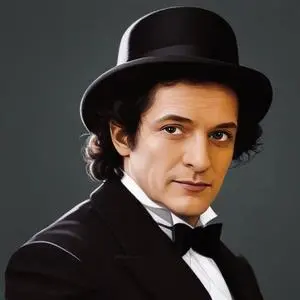
A renowned Russian musician of the Romantic era, celebrated for his virtuosic piano performances and compositions that blended Russian folk elements with Western classical music traditions.
Anton Rubinstein was a Russian pianist, composer, and conductor who founded the Saint Petersburg Conservatory, one of the most prestigious music institutions in Russia. He was renowned for his series of historical recitals, a monumental achievement that showcased his mastery of piano music across the centuries.
Rubinstein was born on November 16, 1829, in Vikhvatinets, Russian Empire (now Ofatini, Transnistria, Republic of Moldova), to Jewish parents who later converted to Russian Orthodoxy. His mother, a talented musician, recognized his musical talent and began giving him piano lessons at the age of five.
Under the guidance of Alexander Villoing, a prominent music teacher, Rubinstein made his public debut at a charity concert at the age of nine. This early start propelled him to pursue a career in music, and he went on to study in Paris, where he was exposed to the works of Chopin, Liszt, and other great composers of the time.
In 1862, Rubinstein founded the Saint Petersburg Conservatory, an institution that would become a hub for Russian music. The conservatory aimed to provide a comprehensive music education, and Rubinstein's vision was to create a space where musicians could develop their skills and contribute to the country's rich cultural heritage.
During his tenure as the conservatory's director, Rubinstein taught some of Russia's most prominent composers, including Pyotr Ilyich Tchaikovsky, who would go on to become one of the country's most beloved composers.
Rubinstein was not only an exceptional pianist but also a prolific composer. He wrote 20 operas, five piano concertos, six symphonies, and numerous solo piano works, chamber music pieces, and choral compositions.
One of his most famous operas, The Demon, is still performed today, and his piano concertos are considered some of the most technically challenging and musically rewarding in the repertoire.
Rubinstein's series of historical recitals, which he performed throughout Russia and Eastern Europe, as well as in the United States, was a groundbreaking achievement. These concerts, which took place between 1885 and 1886, covered the history of piano music from the 16th century to the late 19th century.
This monumental undertaking required an immense amount of research, preparation, and physical endurance, as Rubinstein performed seven consecutive concerts, each lasting several hours.
Anton Rubinstein's legacy is multifaceted. He not only founded the Saint Petersburg Conservatory but also contributed to the development of Russian music, promoting the works of native composers and providing a platform for young talent to emerge.
As a pianist, he set a new standard for technical virtuosity and musicality, inspiring future generations of pianists. His compositions, while not as widely performed today, remain an important part of Russia's musical heritage.
Rubinstein's impact on Russian music cannot be overstated. He was a true pioneer, and his dedication to the arts continues to inspire musicians and music lovers around the world.
Born in 1840
A renowned Russian composer and educator, he is best known for his iconic and beloved ballets, such as Swan Lake and The Nutcracker, which continue to enchant audiences worldwide.
Born in 1839
A Russian master of evocative and dramatic music, famous for his vivid orchestral works, including the iconic "Night on Bald Mountain" and "Pictures at an Exhibition".
Born in 1844
A Russian master of orchestration, known for his vibrant and exotic compositions, such as "Scheherazade" and "Flight of the Bumblebee", that evoke fantastical worlds and mythical creatures.
Born in 1837
A Russian pianist and composer who founded the Mighty Handful, a group of composers who sought to create a distinctly Russian style of classical music, known for his orchestral works and piano pieces.
Born in 1835
A Russian general, composer, and critic who made significant contributions to the development of Russian opera and music criticism, known for his innovative and eclectic compositions.
Born in 1811
A virtuosic pianist and composer who revolutionized classical music with his technically demanding and emotionally expressive works, blending Hungarian folk influences with Romantic-era drama.
Born in 1833
A renowned pianist and composer, he crafted complex, expressive works that blended traditional and innovative techniques, leaving an indelible mark on classical music.
Born in 1810
A renowned Romantic-era composer and influential music critic, known for his expressive and emotionally charged works, including symphonies, piano music, and art songs.
