


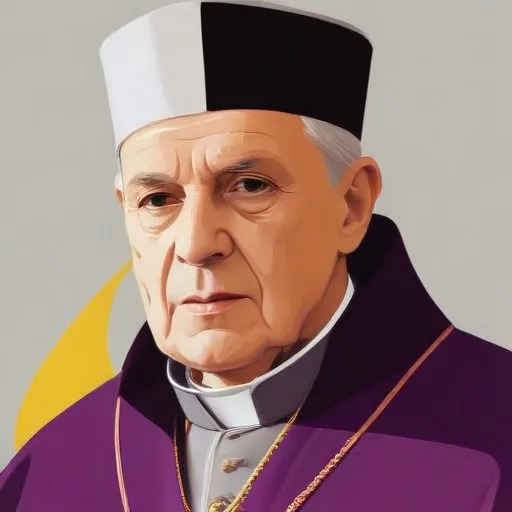
A Polish Catholic archbishop who played a key role in the country's struggle for independence and was a strong advocate for social justice. He's also revered for his humanitarian work during World War I.
As the Archbishop Metropolitan of Warsaw, Antoni Melchior Fijakowski was the spiritual leader of Poland during the tumultuous period of the Partitions of Poland. He is remembered for his steadfast dedication to his faith and his country, guiding the Polish people through times of great turmoil and oppression.
Born on January 3, 1778, in Pszczew, near Poznań, Poland, Fijakowski was raised in a devout Catholic family. He pursued his priestly vocation at the seminary in Poznań and later at the University of Vilnius, where he earned his doctorate in theology.
Fijakowski's remarkable leadership skills and unwavering commitment to his faith quickly earned him recognition within the Catholic Church. He became the suffragan bishop of Warsaw in 1816 and eventually succeeded to the metropolitan see in 1833, a position he held until his passing in 1861.
Fijakowski was a staunch advocate for the preservation of Polish culture and identity. He believed in the importance of education and the role of the Church in promoting national unity. Throughout his life, he worked tirelessly to promote Catholic education and to strengthen the bond between the Church and the Polish people.
Some of Fijakowski's most notable achievements include his efforts to reorganize the Polish Catholic Church, which had been severely weakened by the Partitions. He also played a crucial role in the establishment of the Catholic University of Lublin, which became a beacon of hope for Polish intellectuals and scholars.
Fijakowski's impact on modern Polish society cannot be overstated. He inspired a generation of Polish clergy and intellectuals, who went on to play important roles in shaping the country's future. His legacy continues to be felt today, as Poland remains a predominantly Catholic nation.
Despite the many challenges he faced during his lifetime, Fijakowski remained steadfast in his faith and his commitment to his country. He played a key role in the November Uprising of 1830, which aimed to restore Polish independence. Although the uprising ultimately failed, Fijakowski's involvement demonstrated his unwavering dedication to the Polish people.
Fijakowski's life spans a critical period in Polish history, marked by foreign occupation and national struggle. His leadership and vision helped to sustain the Polish people during this dark period, paving the way for future generations to reclaim their independence.
Fijakowski's leadership and commitment to his faith and country are reminiscent of other notable Polish figures of the time, such as Prince Adam Jerzy Czartoryski. Both men shared a deep love for Poland and a determination to preserve its cultural heritage.
Fijakowski's life serves as a powerful reminder of the importance of faith, perseverance, and service to others. His legacy continues to inspire generations of Poles, who look to him as a shining example of devotion and commitment to one's country.
As we reflect on the life and legacy of Antoni Melchior Fijakowski, we are reminded of the transformative power of faith and leadership. His story serves as a beacon of hope, inspiring us to remain steadfast in our convictions and to work towards a brighter future for ourselves and those around us.
Born in 1499
Reigned from 1559 to 1565, this Pope oversaw the final session of the Council of Trent, shaping Catholic doctrine and practice for centuries to come. He also commissioned the construction of the Sistine Chapel's dome.
