


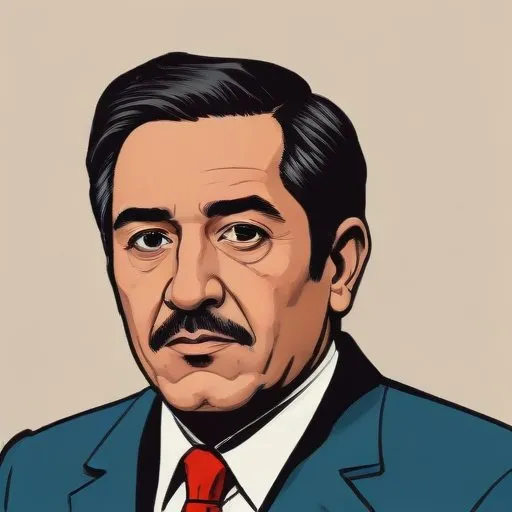
Mexican revolutionary and politician who played a key role in the country's 1910 revolution, advocating for land reform and peasants' rights. He's a national hero in Mexico, celebrated for his commitment to social justice.
Antonio Daz Soto y Gama is renowned for his pivotal role in the Mexican Revolution, fighting tirelessly for social justice and labor rights. As a prominent politician and revolutionary, he played a key role in shaping Mexico's political landscape during the early 20th century.
Born on January 23, 1880, in San Luis Potos, Mexico, Daz Soto y Gama was raised in a family that instilled in him the values of social justice and equality. He pursued his education at the Instituto de la Immaculada Concepcin and later at the Instituto Literario, where he developed a strong foundation in politics and philosophy.
In the early 1900s, Daz Soto y Gama became affiliated with Ricardo Flores Magns' anarchist group, the Mexican Liberal Party (Partido Liberal Mexicano). He actively participated in strikes and uprisings across Mexico, advocating for workers' rights and social reform. His involvement with the Magon brothers' newspaper, El Hijo del Ahuizote, further solidified his position as a champion of social justice.
In 1911, Daz Soto y Gama co-founded the Liberal Party (Partido Liberal) with Magn. However, his activism soon led to his imprisonment and subsequent exile in the United States. During his time in exile, he published a liberal newspaper in El Paso, Social Reform, which vocally opposed the Diaz dictatorship.
With the overthrow of Porfirio Daz in 1911, Daz Soto y Gama returned to Mexico and played a crucial role in the founding of the Casa del Obrero Mundial (House of the World Worker) in Mexico City. This organization aimed to unite workers and promote social reform, further cementing Daz Soto y Gama's reputation as a champion of labor rights.
In 1914, Daz Soto y Gama participated in the Convention of Aguascalientes, where he delivered a controversial speech that sparked protest from some attendees. Despite this, his presence contributed significantly to the adoption of the Zapatista Plan of Ayala, a radical manifesto that called for land reform and social justice.
Antonio Daz Soto y Gama's tireless efforts for social justice and labor rights have left an indelible mark on Mexico's history. His contributions to the Mexican Revolution, the Liberal Party, and the Casa del Obrero Mundial have inspired generations of social activists and reformers. Today, he is remembered as a visionary who fought for a more just and equitable society.
"The Mexican flag symbolizes the triumph of clerical reaction."
— Antonio Daz Soto y Gama, during the Convention of Aguascalientes
Antonio Daz Soto y Gama's fearless advocacy for social justice and labor rights has secured his place in Mexican history as a champion of the people.
Born in 1859
A Mexican revolutionary leader who served as president from 1917 to 1920, known for his role in the Mexican Revolution and drafting the country's 1917 constitution.
Born in 1880
Mexican general and politician who served as the 39th President of Mexico, known for his role in the Mexican Revolution and his efforts to modernize the country. He's also famous for losing his right arm in battle and continuing to serve as president.
Born in 1877
Mexican revolutionary leader who served as president from 1924 to 1928, known for implementing secular and anti-clerical policies, including restricting the Catholic Church's power. He also founded the National Revolutionary Party, which later became the dominant party in Mexico.
Born in 1879
Led a peasant uprising against the Mexican government, fighting for land reform and social justice, and is now a symbol of the Mexican Revolution.
Born in 1878
A legendary figure in the Mexican Revolution, he led a rebellion against the government and robbed trains, becoming a folk hero and symbol of resistance against oppression.
Born in 1850
A ruthless and cunning leader who seized power in Mexico through a coup, known for his brutal suppression of opposition and role in sparking the Mexican Revolution.
