


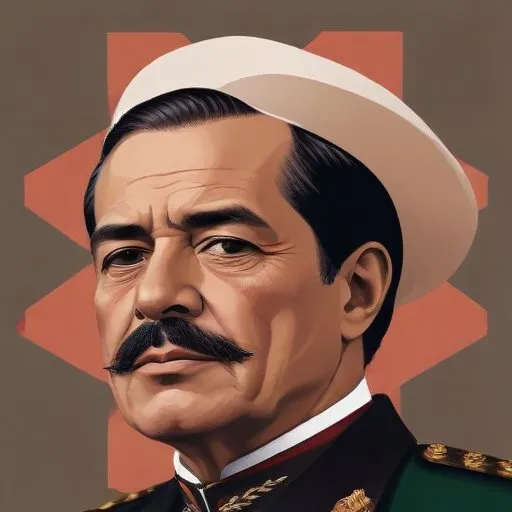
A ruthless and cunning leader who seized power in Mexico through a coup, known for his brutal suppression of opposition and role in sparking the Mexican Revolution.
Victoriano Huerta, a general in the Mexican Federal Army, is notoriously known for seizing power through a coup against the democratically elected government of Francisco I. Madero, marking a tumultuous phase in Mexico's history. His presidency, though short-lived, was marked by violence, armed conflict, and international intrigue.
Huerta's military career spanned several decades, serving under Presidents Porfirio Díaz and Francisco León de la Barra. During the presidency of Madero, Huerta became a high-ranking officer, earning the trust of the president. However, in February 1913, Huerta conspired against Madero, leading to the forced resignation and eventual murder of the president and his vice president.
The coup, backed by the German Empire and the United States under the Taft administration, led to a 17-month presidency marred by violence and bloodshed. The international community was divided, with many foreign powers recognizing the new regime, while the U.S. refused to do so. Huerta's government resisted U.S. incursion into the port of Veracruz, which threatened Mexico's sovereignty, earning him both domestic and international criticism.
In July 1914, the Constitutionalist Army, led by the northern coalition, defeated the Federal Army, forcing Huerta to resign and flee the country to Spain. His presidency, marked by controversy and violence, came to an abrupt end.
Huerta's later life was marked by intrigue and attempted plots, including an attempt to conspire with German spies in the United States during World War I. He was arrested in 1915 and died in 1916, leaving behind a legacy of controversy and violence.
Huerta's presidency and actions had a profound impact on Mexico's history, contributing to the ongoing Mexican Revolution and paving the way for future political instability. His controversial legacy continues to be debated among historians and scholars, serving as a cautionary tale about the dangers of power and corruption.
Huerta's political beliefs and ideology are often shrouded in controversy and mystery. His actions and decisions were often driven by a desire for power and control, rather than any discernible philosophical framework. His legacy serves as a warning about the dangers of unchecked power and the importance of democratic institutions.
Huerta's presidency and actions must be understood within the broader context of the Mexican Revolution, a complex and tumultuous period in Mexico's history. His legacy serves as a reminder of the importance of democratic governance, the dangers of corruption, and the need for accountability in politics.
Born in 1830
A Mexican general and politician who ruled Mexico with an iron fist from 1876 to 1911, modernizing the country while suppressing dissent and opposition. He's infamous for his authoritarian regime and eventual exile.
Born in 1859
A Mexican revolutionary leader who served as president from 1917 to 1920, known for his role in the Mexican Revolution and drafting the country's 1917 constitution.
Born in 1880
Mexican general and politician who served as the 39th President of Mexico, known for his role in the Mexican Revolution and his efforts to modernize the country. He's also famous for losing his right arm in battle and continuing to serve as president.
Born in 1877
Mexican revolutionary leader who served as president from 1924 to 1928, known for implementing secular and anti-clerical policies, including restricting the Catholic Church's power. He also founded the National Revolutionary Party, which later became the dominant party in Mexico.
Born in 1895
A Mexican revolutionary general who served as president, implementing significant land reforms and nationalizing the oil industry, and father of a prominent politician.
Born in 1909
Led Mexico's economic growth and modernization, implementing key social and infrastructure reforms, while also nationalizing the country's electric industry. He's remembered for his progressive policies and commitment to social justice.
91 Years Old
The 52nd President of Mexico, a lawyer and politician who implemented economic reforms and democratization, known for stabilizing the country's economy and introducing neoliberal policies.
