


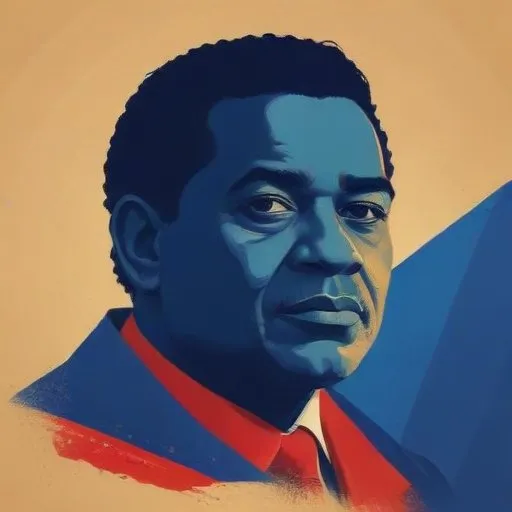
First President of Cape Verde, leading the country to independence from Portugal in 1975 and serving until 1991, known for his role in shaping the nation's early years.
Aristides Pereira is renown for being the first President of Cape Verde, serving from 1975 to 1991, and playing a pivotal role in the country's fight for independence from Portugal. He is also recognized for his efforts in establishing a democratic and socialist nation, albeit with some controversy.
Pereira was born on November 17, 1923, in Fundo das Figueiras, on the island of Boa Vista, Cape Verde. His early career was marked by his involvement in the anticolonial movement, where he organized strikes and rose through the hierarchy of the African Party for the Independence of Guinea and Cape Verde (PAIGC). During this time, he often used the pseudonym Alfredo Bangura.
In 1975, Pereira became the first President of Cape Verde, following the country's independence from Portugal. Initially, he promised to lead a democratic and socialist nation, but his regime was later marred by the suppression of dissent and the restriction of party activity. Despite this, Cape Verde maintained a better human rights record than most African countries and was known for its democratic governance, despite the concentration of power in local citizens' committees and his own government.
During his presidency, Pereira implemented policies aimed at addressing Cape Verde's chronic poverty, including the management of droughts that affected the country. He also maintained a policy of non-alignment, differing from Guinea-Bissau, which remained close to the Soviet Union. This strategic positioning allowed Cape Verde to maintain good relations with both Western and Eastern bloc countries.
Pereira's presidency was marked by a complex relationship with Guinea-Bissau, which was led by his ally, Luís Cabral. However, following Cabral's overthrow in 1980, Pereira cut diplomatic relations with Guinea-Bissau and dissolved the PAIGC, replacing it with the African Party for the Independence of Cape Verde (PAICV). This move was seen as a significant departure from the original goal of uniting the two Lusophone states.
Aristides Pereira's legacy is multifaceted, with some hailing him as a champion of democracy and independence, while others criticize his regime for suppressing dissent and restricting party activity. Nevertheless, he played a crucial role in shaping Cape Verde's trajectory as an independent nation, and his commitment to socialism and non-alignment remains an important aspect of the country's history.
Little is known about Pereira's personal life, although it is reported that he was a humble and unassuming leader who shunned the trappings of power. Following his retirement from politics, Pereira lived a quiet life, passing away on September 22, 2011, at the age of 87.
92 Years Old
The first democratically elected President of Cape Verde, serving from 2001 to 2011, known for his role in the country's transition to democracy and economic development.
82 Years Old
The second President of Cape Verde, serving from 1991 to 2001, known for leading the country's transition to democracy and implementing economic reforms. He's a key figure in Cape Verde's modern history.
66 Years Old
The Prime Minister of Cape Verde who served from 2001 to 2016 and is known for his efforts to promote economic growth and reduce poverty in the country. He also played a key role in maintaining political stability and strengthening democracy in Cape Verde.
Born in 1907
A prominent figure in Cape Verdean literature, known for his poetic and narrative works that explore themes of identity, culture, and colonialism. His writing often blended traditional oral storytelling with modernist techniques.
