


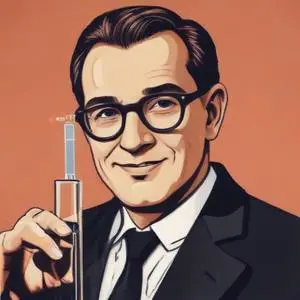
Developed innovative instruments that revolutionized chemical analysis, including the pH meter, and generously supported scientific research and education.
Arnold Orville Beckman, a renowned American chemist and inventor, is best known for revolutionizing the field of analytical chemistry with his invention of the pH meter, a device that measures the acidity or basicity of a solution. This innovation transformed the way scientists work, making it possible to accurately and quickly determine the pH levels of various substances, a crucial aspect in many fields, including medicine, ecology, and food science.
Beckman was born on April 10, 1900, in Cullom, Illinois, to a family of farmers. His early life was marked by a strong curiosity and interest in science, which led him to pursue higher education. He earned his Bachelor's degree in chemistry from the University of Illinois in 1922, followed by a Ph.D. in physical chemistry from California Institute of Technology (Caltech) in 1928.
In the 1930s, Beckman's work at Caltech focused on developing a device that could accurately measure pH levels. At the time, existing methods were time-consuming and prone to errors. Beckman's breakthrough came in 1934 when he invented the first pH meter, which consisted of a glass electrode that could detect changes in pH levels. This invention earned him a patent and catapulted him to fame in the scientific community.
Beckman was a firm believer in the importance of innovation and entrepreneurship in science. He felt that scientists had a responsibility to apply their knowledge to real-world problems and to develop practical solutions that could benefit society. Throughout his career, Beckman embodied this philosophy, founding several companies, including Beckman Instruments, which became a leading manufacturer of scientific instruments.
Beckman's contributions to science went beyond the pH meter. He made significant advancements in the fields of spectroscopy, electrochemistry, and biomedical engineering. Some of his notable works include the development of the DU spectrophotometer, the first commercially available ultraviolet spectrophotometer, and the Beckman Model E Analytrol, an automated analytical instrument.
Beckman's remarkable achievements were recognized with numerous awards and honors, including the National Medal of Science, the Perkin Medal, and the IRI Medal. He was also elected to the National Academy of Sciences and the American Academy of Arts and Sciences.
Beckman's invention of the pH meter and his philosophical approach to science have had a profound impact on various fields, from medicine to environmental science. His work has inspired generations of scientists and entrepreneurs, and his legacy continues to shape the way we approach scientific innovation and problem-solving.
In conclusion, Arnold Orville Beckman was a true pioneer in the field of analytical chemistry, and his contributions have left an indelible mark on science and society. His story serves as a testament to the power of innovation, entrepreneurship, and the pursuit of knowledge.
Born in 1901
Pioneering chemist and peace activist who won two unshared Nobel Prizes, one for chemistry and one for peace, for his groundbreaking work on the nature of the chemical bond and his tireless efforts to promote nuclear disarmament.
Born in 1918
A brilliant physicist and engineer who pioneered quantum mechanics and famously explained complex concepts in simple terms, making science accessible to all.
97 Years Old
A pioneer in particle physics, discovering subatomic particles like quarks and gluons, and developing the theory of quantum chromodynamics.
Born in 1881
A pioneer in aerodynamics and fluid dynamics, known for his groundbreaking work on vortex streets and supersonic flight, as well as being a founder of NASA's Jet Propulsion Laboratory.
Born in 1910
Legendary basketball coach who led UCLA to 10 NCAA championships and is renowned for his "Pyramid of Success" philosophy. He is a symbol of excellence and integrity in sports.
