


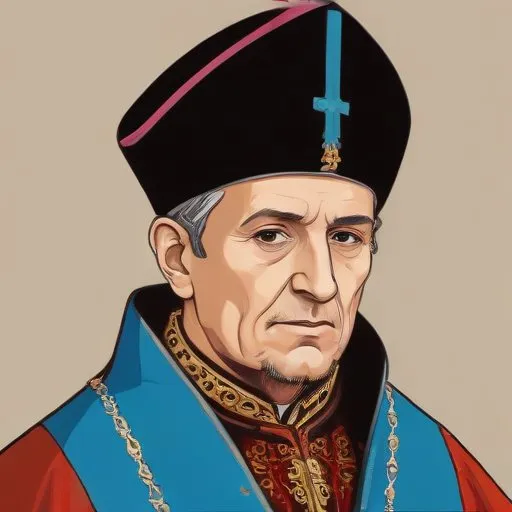
The first Bohemian archbishop, a 14th-century Czech cleric who played a key role in establishing the Archdiocese of Prague and promoting Catholicism in Bohemia. He's also credited with founding the city of Pardubice.
Arnot of Pardubice, also known as Ernst von Pardubitz, was a Czech archbishop, diplomat, and advisor to Emperor Charles IV, who left an indelible mark on the city of Prague and its cultural landscape. As the first Archbishop of Prague and the last bishop, Arnot's contributions to the city's educational, ecclesiastical, and cultural development are still celebrated to this day.
Born on March 25, 1297, in Hostinka, today part of Vestec, Arnot was the eldest son of Knight Arnot of Hostinka. He spent his childhood in Kodzko, where he developed a strong foundation for his future endeavors. In 1340, Arnot inherited the town of Pardubice, which would become a significant milestone in his life.
On March 11, 1343, Arnot was confirmed as the bishop of Prague, and a year later, on May 8, 1344, he was commissioned as the first Archbishop of Prague. This appointment marked the beginning of a new era in the city's ecclesiastical history, with Arnot playing a pivotal role in shaping its future.
One of Arnot's most significant contributions was his support for the newly founded Charles University, established in the 14th century. He ordered the monks to contribute to the university, thereby enhancing the quality of education in the institution. This move not only fostered a culture of learning but also cemented Arnot's reputation as a visionary leader.
As an advisor and diplomat to Emperor Charles IV, Arnot played a crucial role in shaping the city's international relations and diplomatic landscape. His diplomatic prowess earned him recognition and respect throughout the region, solidifying his legacy as a statesman and leader.
Throughout his life, Arnot was driven by a sense of purpose and duty. His commitment to education, culture, and diplomacy earned him numerous accolades and recognition. His appointment as the first Archbishop of Prague, his support for Charles University, and his diplomatic career are testaments to his remarkable life and achievements.
Arnot's life and legacy are a testament to the complex and dynamic nature of 14th-century Prague. His contributions to education, culture, and diplomacy continue to influence the city to this day, making him an integral part of Prague's rich cultural heritage. As the first Archbishop of Prague, Arnot set a high standard for his successors, ensuring that his legacy would endure for generations to come.
Arnot's contemporaries, including Emperor Charles IV and other notable figures of the time, recognized his unique blend of intelligence, diplomacy, and vision. While others focused on military conquests or territorial expansion, Arnot's dedication to education, culture, and diplomacy set him apart as a true statesman and leader.
Arnot's legacy extends far beyond his own lifetime. His support for education and culture continues to shape the city of Prague, while his diplomatic career serves as a model for effective international relations. As a testament to his enduring influence, Arnot remains an important figure in Czech history and culture.
Arnot of Pardubice was a truly remarkable individual, whose life and legacy continue to inspire and educate us to this day. As a visionary leader, diplomat, and educator, he left an indelible mark on the city of Prague and its cultural landscape. His story serves as a testament to the power of dedication, hard work, and a commitment to making a positive impact on the world.
Born in 1500
Ruling over a vast empire from 1519 to 1556, he was a powerful and influential leader who played a crucial role in shaping European politics and religion. He is most known for his efforts to unify Christian Europe and defend it against the Ottoman Empire.
Born in 1337
Ruler of Luxembourg from 1354 to 1383, known for his military campaigns and territorial expansions, particularly the acquisition of the County of Chiny.
Born in 1483
A German monk and priest who sparked the Protestant Reformation, challenging Catholic Church authority and shaping Western Christianity. He's famous for nailing 95 theses to a church door, sparking a religious revolution.
