


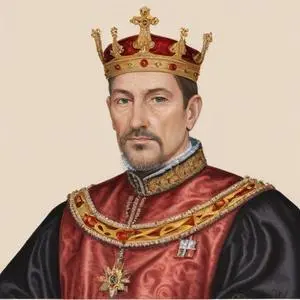
Ruling over a vast empire from 1519 to 1556, he was a powerful and influential leader who played a crucial role in shaping European politics and religion. He is most known for his efforts to unify Christian Europe and defend it against the Ottoman Empire.
Charles V, Holy Roman Emperor, is remembered as one of the most powerful and influential rulers of the 16th century. He was the mastermind behind the vast empire that spanned across Europe and the Americas, earning him the nickname "The Empire Where the Sun Never Sets."
Born on February 24, 1500, in Flanders, Charles was the heir to the rising House of Habsburg. He was the son of Philip the Handsome, Archduke of Austria, and Joanna of Castile, daughter of the Catholic Monarchs of Spain, Isabella I and Ferdinand II of Aragon.
After his father's death in 1506, Charles inherited the Low Countries. In 1516, he became King of Spain as co-monarch of Castile and Aragon with his mother. Following the death of his grandfather, Maximilian I, in 1519, Charles inherited the Austrian hereditary lands and was elected as Holy Roman Emperor.
Charles revitalized the medieval concept of universal monarchy, adopting the Imperial name of Charles V as his main title. He styled himself as a new Charlemagne, becoming the first ruler to unite the crowns of the Holy Roman Empire, Spain, and the Netherlands.
With no fixed capital, Charles made 40 journeys through the different entities he ruled, spending a quarter of his reign traveling within his realms. Although his empire came to him peacefully, he spent most of his life waging war, exhausting his revenues and leaving debts behind.
Charles V's reign marked the beginning of Spanish colonization in the Americas, and his legacy can be seen in the modern-day borders of many European and American countries. He was a patron of the arts, commissioning works from famous artists such as Titian and Ferdinand Cortés.
"I speak Spanish to God, Italian to women, French to men, and German to my horse." - Charles V
Charles V's reign marked the beginning of modern nation-states, with his empire laying the foundation for the modern-day borders of many European and American countries. His legacy can be seen in the cultural, linguistic, and artistic exchange between Europe and the Americas.
Charles V's reign was marked by the Renaissance, the Protestant Reformation, and the rise of nation-states. He played a crucial role in shaping the modern world, with his legacy continuing to influence politics, culture, and society to this day.
Born in 1380
Unified the Crown of Aragon, ruling over a vast territory in eastern Spain, and sponsored the voyages of Christopher Columbus, leading to the discovery of the New World.
Born in 1451
Unified the Spanish kingdoms, sponsored Christopher Columbus's voyage to the Americas, and established the Spanish Inquisition.
Born in 1536
Led the Catholic Church during a tumultuous period, issuing papal bulls and playing a key role in the Counter-Reformation. He's also famous for his coffee habit, being the first Pope to try and approve of it.
Born in 1491
A larger-than-life monarch who ruled England with an iron fist, infamous for his six marriages and the English Reformation.
Born in 1494
Ruling the Ottoman Empire at its peak, he expanded its borders, conquered Belgrade, and laid siege to Vienna, earning a reputation as a brilliant military strategist and statesman. He also codified laws and reformed the empire's administration.
Born in 1483
A German monk and priest who sparked the Protestant Reformation, challenging Catholic Church authority and shaping Western Christianity. He's famous for nailing 95 theses to a church door, sparking a religious revolution.
