


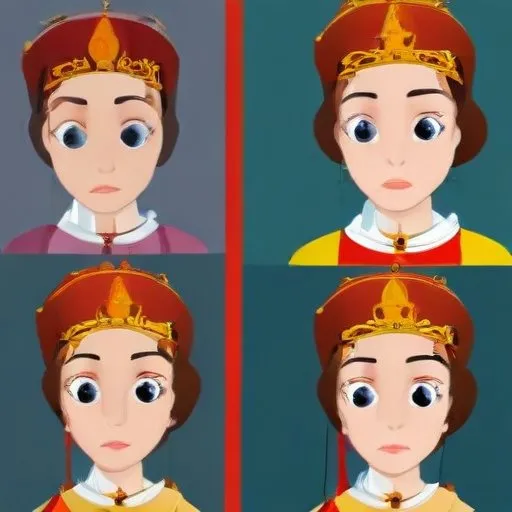
Queen consort of Spain, married to Charles V, and a skilled politician who played a crucial role in governing the empire during her husband's absences. She was a patron of the arts and a strong supporter of the Spanish Inquisition.
Isabella of Portugal, also known as Isabel of Aragon, is renowned for her illustrious marriage to Charles V, Holy Roman Emperor, and her subsequent role as Empress of the Holy Roman Empire. Through her union, she not only solidified the bond between the Trastámara and Habsburg dynasties but also played a crucial role in shaping the course of European politics and diplomacy.
Born on October 24, 1503, in Lisbon, Portugal, Isabella was the daughter of King Manuel I of Portugal and his second wife, Maria of Aragon. Her familial ties to the powerful monarchies of Spain and Portugal ensured her prominence in the intricate web of royal alliances and strategic marriages that characterized early modern Europe.
In 1526, Isabella wed Charles V, cementing the union between their respective families and paving the way for the expansion of Habsburg influence across the continent. As Empress, she actively participated in state affairs, utilizing her diplomatic acumen to navigate the complex landscape of European politics. Her unwavering loyalty to her husband and the empire earned her the respect and admiration of contemporaries and historians alike.
Isabella's intellectual pursuits and cultural patronage were instrumental in fostering a Renaissance-inspired cultural renaissance within the empire. Her support for humanist scholars and artists contributed to the advancement of learning and the arts, reflecting her deep-seated appreciation for the classical ideals of beauty and wisdom.
Isabella's legacy extends far beyond her role as a royal consort. Her diplomatic prowess, cultural patronage, and intellectual curiosity all contributed to the shaping of the Habsburg Empire's grandeur. As a symbol of dynastic unity and imperial ambition, her life and reign continue to captivate historians and scholars, offering valuable insights into the intricate dynamics of early modern European politics and society.
The lasting impact of Isabella's reign can be seen in the enduring cultural and artistic achievements of the Habsburg Empire. Her patronage of the arts and humanism helped lay the groundwork for the Enlightenment and the emergence of modern European culture. Furthermore, her exemplary role as a powerful female figure in a patriarchal society has inspired generations of women to pursue careers in politics, diplomacy, and leadership.
In recognition of her remarkable life and contributions, Isabella has been immortalized through various artistic and cultural tributes. Her legacy continues to be celebrated through numerous portraits, sculptures, and literary works, solidifying her position as one of the most enduring and iconic figures in European history.
Isabella of Portugal, Empress of the Holy Roman Empire, left an indelible mark on European history. Through her diplomatic acumen, cultural patronage, and intellectual pursuits, she played a pivotal role in shaping the course of modern European politics and society. Her remarkable life and legacy continue to captivate and inspire, serving as a testament to the power and resilience of women in leadership.
Born in 1455
King of Portugal from 1481 to 1495, known for his centralizing policies, establishing a strong monarchy, and sponsoring explorers like Bartolomeu Dias and Vasco da Gama.
Born in 1469
King of Portugal from 1495 to 1521, known for sponsoring Vasco da Gama's voyage to India, establishing trade routes, and promoting the Portuguese Renaissance.
Born in 1500
Ruling over a vast empire from 1519 to 1556, he was a powerful and influential leader who played a crucial role in shaping European politics and religion. He is most known for his efforts to unify Christian Europe and defend it against the Ottoman Empire.
Born in 1451
Unified the Spanish kingdoms, sponsored Christopher Columbus's voyage to the Americas, and established the Spanish Inquisition.
Born in 1380
Unified the Crown of Aragon, ruling over a vast territory in eastern Spain, and sponsored the voyages of Christopher Columbus, leading to the discovery of the New World.
