


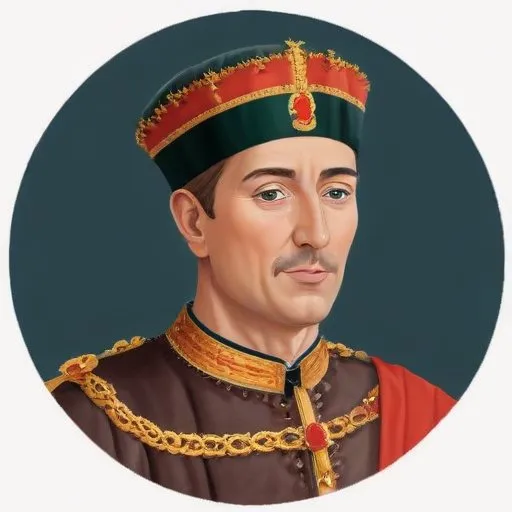
King of Portugal from 1481 to 1495, known for his centralizing policies, establishing a strong monarchy, and sponsoring explorers like Bartolomeu Dias and Vasco da Gama.
Known as the "Perfect Prince" (o Principe Perfeito), John II of Portugal was a visionary monarch who reestablished the power of the Portuguese monarchy, revitalized the economy, and reignited his country's exploration of Africa and Asia. During his reign from 1481 to 1495, John II implemented sweeping reforms, expanded Portugal's reach, and left an indelible mark on history.
Born on May 3, 1455, in Lisbon, John was the second son of Afonso V of Portugal and Isabella of Coimbra. At just one month old, he was declared the legitimate heir to the crown and received an oath of allegiance from the three estates. Thisearly recognition solidified his position as the future king of Portugal.
In 1468, John's father, Afonso V, attempted to arrange a double marriage with Henry IV of Castile, where John would marry Henry's daughter, Joanna, and Afonso would marry Henry's niece and heir presumptive, Isabella of Castile. However, Isabella refused to consent, and John instead married his first cousin, Eleanor of Viseu, the eldest daughter of Ferdinand, Duke of Viseu, in 1471. This strategic marriage cemented alliances and secured John's position as a future leader.
John accompanied his father on campaigns in northern Africa and was knighted after the victory in the Conquest of Arzila in August 1471. He later participated in the War of Castilian Succession, where he urged his father to marry Joanna and invade Castile. Although the plan was ultimately unsuccessful, John's military prowess and strategic thinking earned him recognition as a capable leader.
As king, John II implemented a range of reforms, including:
These reforms and achievements earned John II the admiration of his contemporaries and secured his legacy as one of Portugal's greatest monarchs.
John II's reign had a lasting impact on Portuguese society and beyond. His emphasis on exploration and discovery paved the way for Portugal's Golden Age of Exploration, while his economic reforms laid the foundation for the country's future prosperity.
John II's reign marked a turning point in Portuguese history, as he restored the power of the monarchy and set the country on a path of exploration, discovery, and growth. His legacy extends far beyond his own lifetime, shaping the course of Portuguese history and influencing the development of Western civilization.
John II's life was marked by significant events, including:
These personal milestones and key life events showcase John II's growth from a young prince to a confident and visionary leader.
Born in 1432
King of Portugal who ruled from 1438 to 1481, known for his military conquests in North Africa and the expansion of Portuguese trade and exploration.
Born in 1458
Queen of Portugal from 1475 to 1481, known for her strong personality, cultural patronage, and role in shaping the country's politics and arts.
Born in 1380
Unified the Crown of Aragon, ruling over a vast territory in eastern Spain, and sponsored the voyages of Christopher Columbus, leading to the discovery of the New World.
Born in 1451
Unified the Spanish kingdoms, sponsored Christopher Columbus's voyage to the Americas, and established the Spanish Inquisition.
Born in 1469
King of Portugal from 1495 to 1521, known for sponsoring Vasco da Gama's voyage to India, establishing trade routes, and promoting the Portuguese Renaissance.
Born in 1394
A Portuguese prince who sponsored and organized numerous expeditions to explore and map the west coast of Africa, leading to the discovery of new trade routes and territories. He played a crucial role in the Age of Exploration.
Born in 1320
King of Portugal who ruled from 1357 to 1367 and is remembered for his brutal suppression of the nobility and his role in the Portuguese succession crisis. He's also known for his tumultuous personal life, including the murder of his mistress's lover.
