


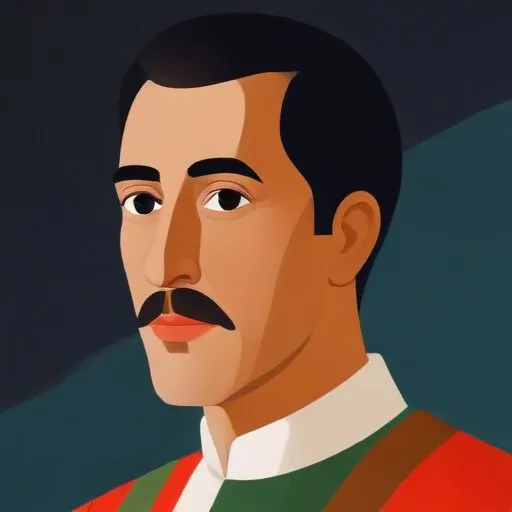
King of Portugal who ruled from 1438 to 1481, known for his military conquests in North Africa and the expansion of Portuguese trade and exploration.
Afonso V, known as "the African" (Portuguese: o Africano), was the King of Portugal from 1438 to 1481, with a brief interruption in 1477. He earned his sobriquet due to his numerous military conquests in Northern Africa, which expanded Portugal's territories and established it as a major naval power.
Afonso was born on January 15, 1432, in Sintra, Portugal, as the second son of King Edward of Portugal and his wife, Eleanor of Aragon. Following the death of his older brother, Infante João, in 1429-1433, Afonso became the heir apparent and was made the first Prince of Portugal by his father, a title that distinguished him from the other children of the monarch.
Afonso was only six years old when he succeeded his father in 1438. During his minority, he was placed under the regency of his mother, Eleanor, according to his father's will. However, as both a foreigner and a woman, Eleanor was not a popular choice for regent, leading the cortes (Portuguese parliament) to pass a law requiring a joint regency consisting of Eleanor and Pedro, Duke of Coimbra, the younger brother of the late king.
The dual regency proved to be a failure, and in 1439, the cortes named Pedro protector and guardian of the king and ruler and defender of the kingdom. Eleanor attempted to resist, but without support in Portugal, she fled to Castile. Pedro's main policies focused on restricting the political power of the great noble houses and expanding the powers of the crown. Although the country prospered under his rule, it was not without conflict, as his laws interfered with the ambitions of powerful nobles.
Afonso V is renowned for his military conquests in Northern Africa, which expanded Portugal's territories and established it as a major naval power. He conquered several cities, including Tangier, Alcácer Ceguer, and Arzila, and established trade relationships with other African kingdoms. His military campaigns and diplomatic efforts earned him the respect and admiration of his contemporaries, solidifying his legacy as a great king.
Afonso V's reign marked a significant period in Portuguese history, as it witnessed the expansion of the country's territories, the establishment of trade relationships with other African kingdoms, and the consolidation of power in the hands of the monarch. His military conquests and diplomatic efforts earned him the respect and admiration of his contemporaries, solidifying his legacy as a great king.
| Year | Event |
|---|---|
| 1432 | Born in Sintra, Portugal |
| 1438 | Succeeded his father as King of Portugal |
| 1439 | Joint regency with Pedro, Duke of Coimbra, and his mother Eleanor |
| 1442 | Appointed Pedro, Duke of Coimbra, as his uncle and protector |
| 1445 | Began his military campaigns in Northern Africa |
| 1477 | Brief interruption in his reign, when he was deposed by his son, John II |
| 1481 | Died on August 28, at the age of 49 |
Afonso V's legacy continues to inspire and fascinate historians and scholars to this day, serving as a testament to his remarkable achievements as a military leader, statesman, and king.
Born in 1455
King of Portugal from 1481 to 1495, known for his centralizing policies, establishing a strong monarchy, and sponsoring explorers like Bartolomeu Dias and Vasco da Gama.
Born in 1358
The queen who married John I of Castile and played a crucial role in the unification of Spain, known for her strong diplomatic skills and strategic alliances. She was a powerful queen consort who influenced royal decisions and shaped the course of Spanish history.
Born in 1394
A Portuguese prince who sponsored and organized numerous expeditions to explore and map the west coast of Africa, leading to the discovery of new trade routes and territories. He played a crucial role in the Age of Exploration.
Born in 1397
Queen consort of Spain, married to Charles V, and a skilled politician who played a crucial role in governing the empire during her husband's absences. She was a patron of the arts and a strong supporter of the Spanish Inquisition.
Born in 1462
Daughter of King Henry IV of Castile, she was a claimant to the throne and sparked a dynastic crisis that led to the rise of the Catholic Monarchs. Her disputed legitimacy fueled a war of succession.
