


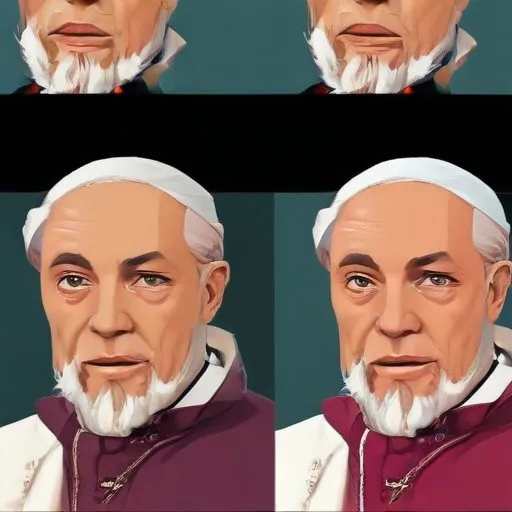
Led the Catholic Church during a tumultuous period, issuing papal bulls and playing a key role in the Counter-Reformation. He's also famous for his coffee habit, being the first Pope to try and approve of it.
As the 231st Pope of the Catholic Church, Pope Clement VIII is renowned for reconciling Henry IV of France to the Catholic faith, thereby strengthening the Church's unity and solidifying its position amidst the tumultuous era of the Renaissance. His papacy, marked by diplomatic prowess and theological acumen, earned him a revered place in the annals of Catholic history.
Born Ippolito Aldobrandini on February 24, 1536, in Fano, Italy, Pope Clement VIII hailed from a prominent Florentine family. He initially followed in his father's footsteps as a canon lawyer, becoming an Auditor judge of the Roman Rota, the highest ecclesiastical court constituted by the Holy See. Although he was ordained as a priest at the age of 45, his administrative skills and theological expertise propelled him to the forefront of the Catholic Church.
In 1585, Pope Sixtus V appointed Aldobrandini as Cardinal-Priest of S. Pancrazio, a position that catapulted him to greater prominence. As major penitentiary, he demonstrated his diplomatic acumen by negotiating the release of the Habsburgs in Poland. Aldobrandini's spiritual director, Saint Philip Neri, played a significant role in shaping his values and vision for the Church.
On February 2, 1592, Aldobrandini was elected Pope, adopting the name Clement VIII. During his papacy, he oversaw the reconciliation of Henry IV of France to the Catholic faith, forging a crucial alliance between Christian nations to counter the Ottoman Empire's expansionist policies. This achievement solidified his reputation as a skilled diplomat and a champion of Christian unity.
Despite his numerous achievements, Pope Clement VIII faced criticism for his involvement in the trial and execution of Giordano Bruno, a Dominican friar accused of heresy. Additionally, his strict measures against Jewish residents of the Papal States have been widely debated among historians.
Pope Clement VIII's legacy extends beyond his papacy, as he is often credited with being the first pope to drink coffee. His remains rest in the Roman church of Santa Maria Maggiore, a testament to his enduring impact on the Catholic Church. He died on March 3, 1605, at the age of 69, leaving behind a rich legacy of unity, diplomacy, and theological acumen.
Throughout his life, Pope Clement VIII embodied the spirit of charity, humility, and wisdom, earning him a revered place in the annals of Catholic history.
Born in 1535
The second shortest-reigning pope in history, serving for just 27 days in 1605, he is most known for his brief but tumultuous papacy marked by power struggles and controversy.
Born in 1568
The 17th-century Catholic leader who reigned for 21 years, known for his strong stance against Galileo Galilei and his scientific discoveries, as well as his extensive patronage of the arts.
Born in 1611
Led the Catholic Church during a tumultuous period, reforming the Church's finances and combating corruption, while also opposing the French monarch's attempts to exert control over the Church.
Born in 1599
A 17th-century pope who commissioned grand architectural projects, including the colonnade of St. Peter's Square, and was a patron of the arts.
Born in 1611
Led the Catholic Church during a tumultuous period, reforming the Church's finances and combating corruption, while also opposing the French monarch's attempts to exert control over the Church.
Born in 1652
The 18th-century Pope who banned Freemasonry and reformed the Roman Curia, leaving a lasting impact on the Catholic Church's governance and relations with secret societies.
Born in 1650
A Dominican friar who played a key role in the Western Schism, issuing several bulls to assert his authority and legitimacy as the true pope. He's also known for his reforms and attempts to restore the church's discipline.
Born in 1876
The leader of the Catholic Church from 1939 to 1958, known for his controversial role during World War II, particularly in regards to the Holocaust. He is also remembered for his encyclicals on social justice and liturgical reforms.
