


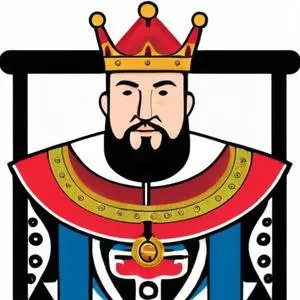
A larger-than-life monarch who ruled England with an iron fist, infamous for his six marriages and the English Reformation.
When one thinks of Henry VIII, the first thing that comes to mind is his remarkable reign as the King of England from 1509 to 1547, and, of course, his infamous six marriages. Henry's extravagant lifestyle, tyrannical rule, and significant impact on the English Reformation have cemented his place in history as one of the most fascinating and controversial figures of the 16th century.
Born on June 28, 1491, to King Henry VII and Elizabeth of York, Henry VIII was the second son, but after the death of his older brother, Arthur, he became the heir apparent. Henry's early life was marked by a strong education, athletic prowess, and a deep love for the arts. In 1509, at the age of 17, Henry succeeded his father to the throne, and his reign was initially marked by a sense of optimism and promise.
One of the most defining aspects of Henry's reign was his tumultuous marriages to six different wives. These wives, in order, were:
Henry's desire to annul his marriage to Catherine of Aragon led to the English Reformation, a significant turning point in English history. The Reformation saw Henry break away from the Roman Catholic Church, establish the Church of England, and appoint himself as its head. This move had far-reaching consequences, including the Dissolution of the Monasteries, the establishment of the Anglican Church, and the execution of Thomas More and John Fisher, who refused to recognize Henry as the head of the Church.
Beyond his tumultuous personal life and religious upheaval, Henry VIII was a prolific builder, and his reign saw the construction of many palaces, including Hampton Court Palace and Whitehall Palace. He was also a patron of the arts, and his court attracted scholars, poets, and musicians from across Europe.
Henry's legacy is complex and multifaceted. While he is often remembered for his tyranny, extravagance, and brutal treatment of his wives, he also played a significant role in shaping the course of English history, establishing the Church of England, and leaving behind a rich cultural and architectural heritage.
Some notable events in Henry's life include:
Did you know that Henry VIII was a talented musician and composer? He even wrote a popular song called "Green Groweth the Holly"!
Despite his larger-than-life personality, Henry's reign was marked by significant economic and cultural achievements. He was a true Renaissance man, and his legacy continues to fascinate and inspire us to this day.
Born in 1485
Spanish princess who became the queen consort of England, playing a central role in the English Reformation and sparking the creation of the Church of England.
75 Years Old
A renowned actress, producer, and jewelry designer, best known for her iconic roles in film and television, including the Bond girl Solitaire and Dr. Quinn, Medicine Woman.
Born in 1478
A renowned Renaissance humanist and statesman who served as Lord Chancellor of England, famous for his literary work "Utopia" and his martyrdom for refusing to acknowledge the English monarch's supremacy over the Church.
Born in 1533
The Virgin Queen, a powerful and beloved monarch, ruled England during a golden age of culture, literature, and exploration, establishing the Church of England and defeating the Spanish Armada.
