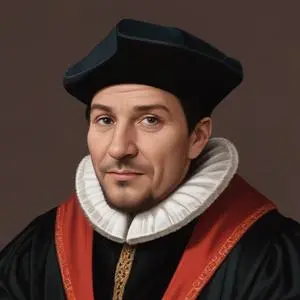
Sir Thomas More: The Renaissance Humanist and Martyr
A Visionary Statesman and Author
Sir Thomas More is renowned for his groundbreaking work,
Utopia, a seminal book that describes the political system of an imaginary island state, published in 1516. As an English lawyer, judge, social philosopher, author, statesman, and amateur theologian, More's multifaceted career has left an indelible mark on history.
Early Life and Education
Born on Milk Street in the City of London on 7 February 1478, Thomas More was the son of Sir John More, a successful lawyer and later a judge, and his wife Agnes née Graunger. He was the second of six children. More received his education at St. Anthony's School, considered one of London's best schools, and later served John Morton, the Archbishop of Canterbury and Lord Chancellor of England, as a household page. Morton's enthusiasm for the New Learning scholarship, later known as humanism or London humanism, led him to nominate More for a place at the University of Oxford.
A Climbing Star in Politics
More began his studies at Oxford in 1492, receiving a classical education. He rose through the ranks of politics, serving as a Member of Parliament, a Privy Counsellor, and eventually, the Lord High Chancellor of England from October 1529 to May 1532 under King Henry VIII. More's intellectual prowess and strong sense of justice earned him respect and admiration among his contemporaries.
A Devout Catholic and Opponent of the Reformation
More was a devout Catholic and vehemently opposed the Protestant Reformation, directing polemics against the theology of
Martin Luther,
Huldrych Zwingli, and William Tyndale. His steadfast commitment to the Catholic faith led him to refuse Henry VIII's demand to acknowledge the king as the supreme head of the Church of England and to recognize the annulment of his marriage to Catherine of Aragon.
A Martyr's Legacy
In 1534, More refused to take the Oath of Supremacy, which led to his conviction of treason based on what he claimed was false evidence. On 6 July 1535, More was executed on Tower Hill. At his execution, he uttered the famous phrase, "I die the King's good servant, and God's first." More's unwavering loyalty to his faith and principles has earned him a revered place in history as a martyr.
Sainthood and Patronage
In 1935,
Pope Pius XI canonized More as a martyr. Later, in 2000,
Pope John Paul II declared him the patron saint of statesmen and politicians. More's legacy extends beyond his literary and political achievements, serving as a beacon of faith, integrity, and courage in the face of adversity.
Philosophical Contributions and Beliefs
More's philosophical contributions are rooted in his humanist ideals, emphasizing the importance of education, reason, and individualism. His concept of
Utopia, a imaginary island state where reason and justice prevail, has influenced thinkers and politicians for centuries.
Personal Milestones and Key Life Events
- 1478: Born on Milk Street in the City of London
- 1490-1492: Served John Morton, the Archbishop of Canterbury and Lord Chancellor of England, as a household page
- 1492: Began studies at the University of Oxford
- 1516: Published Utopia
- 1529-1532: Served as Lord High Chancellor of England
- 1534: Refused to take the Oath of Supremacy
- 1535: Executed on Tower Hill
Quotes and Memorable Sayings
- "I die the King's good servant, and God's first."
- "The things that we pray for, God gives us; but he gives us them in His own way, not in ours."
More's enduring legacy serves as a testament to his unwavering commitment to his faith, principles, and ideals. As a statesman, philosopher, and author, he has left an indelible mark on history, inspiring generations to come.
FAQ
What was Thomas Mores role in the English Reformation?
Thomas More was a strong opponent of the English Reformation, which sought to break away from the authority of the Roman Catholic Church. As Lord Chancellor, he actively persecuted Protestant reformers and heretics, earning him the nickname the bitter tormentor of the Protestants.
What was the significance of Thomas Mores book, Utopia?
Thomas Mores book, Utopia, published in 1516, is a seminal work of Renaissance humanism that describes an imaginary island society with a highly egalitarian and just social order. It is considered a groundbreaking work of literary and philosophical fiction.
What was Thomas Mores relationship with King Henry VIII?
Thomas More was a close advisor and friend to King Henry VIII, serving as Lord Chancellor from 1529 to 1532. However, their relationship deteriorated when Henry VIII sought to annul his marriage to Catherine of Aragon, which More refused to support.
Why was Thomas More executed, and what was his final statement?
Thomas More was executed by beheading in 1535 for treason, refusing to recognize King Henry VIII as the supreme head of the Church of England. His final statement was I die the kings good servant, but Gods first.
What is Thomas Mores legacy, and how is he remembered today?
Thomas More is remembered as a humanist, philosopher, and statesman who embodied the values of the Renaissance. He is also celebrated as a martyr and saint by the Catholic Church, with his feast day on July 6.