


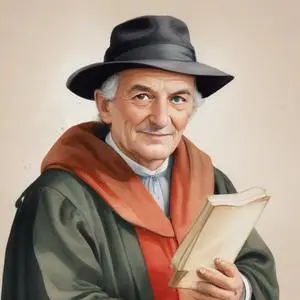
A 16th-century Renaissance humanist who advocated for education, tolerance, and critical thinking, and is famous for his witty and insightful writings, particularly "In Praise of Folly".
Desiderius Erasmus Roterodamus, known to the world as Erasmus of Rotterdam, was a 16th-century Dutch Christian humanist, Catholic theologian, educationalist, satirist, and philosopher who left an indelible mark on Western culture. Through his prolific writings, which include translations, books, essays, prayers, and letters, Erasmus is considered one of the most influential thinkers of the Northern Renaissance.
Erasmus's work was characterized by his advocacy for peaceable concord and pastoral tolerance on matters of indifference. He developed a biblical humanistic theology that promoted the traditional doctrine of synergism, which posits that salvation is a collaborative effort between humanity and God. This approach drew criticism from prominent Reformers such as Martin Luther and John Calvin, who favored the doctrine of monergism.
Erasmus's writings were instrumental in shaping the Renaissance humanist movement. Some of his notable works include:
Erasmus's life can be divided into four distinct quarters:
Childhood: Born around 1466, Erasmus was orphaned and impoverished, forcing him to rely on his wit and intellect to make a name for himself.
Canon Years: Erasmus spent his early adulthood as a canon, a kind of semimonk, struggling to make a living and find his place in the world.
Priesthood and Scholarship: Erasmus's literary talents earned him recognition, and he became a priest and scholar, devoting himself to classical scholarship and biblical studies.
Later Years: Despite facing criticism and controversy, Erasmus remained committed to reforming the Catholic Church from within, promoting peace and tolerance until his death in 1536.
Erasmus's emphasis on education, critical thinking, and individualism has had a lasting impact on Western society. His advocacy for peace and tolerance has inspired generations of scholars, theologians, and philosophers. The Erasmian approach to classical scholarship has shaped the way we understand and interpret ancient texts.
Erasmus's life and work were shaped by the tumultuous backdrop of the European religious Reformations. Despite his critics, he remained committed to his convictions, leaving behind a rich legacy of scholarship, literature, and philosophical inquiry. His influence extends beyond the Renaissance, echoing through the corridors of modern thought and culture.
Did you know that Erasmus was a prolific letter-writer, penning over 3,000 letters during his lifetime? His correspondence provides valuable insights into the Renaissance mind and its cultural landscape.
Erasmus's love of books was renowned. He amassed an impressive library, which was later sold to support his scholarly endeavors.
Born in 1483
A German monk and priest who sparked the Protestant Reformation, challenging Catholic Church authority and shaping Western Christianity. He's famous for nailing 95 theses to a church door, sparking a religious revolution.
Born in 1509
A French pastor and theologian who played a key role in the Protestant Reformation, shaping Christian theology and influencing Western civilization. He's famous for his teachings on predestination and his role in establishing Calvinism.
Born in 1497
A 16th-century Renaissance scholar who made significant contributions to the development of the Protestant Reformation and education, known for his theological writings and astronomical observations.
Born in 1484
Leader of the Swiss Reformation, advocating for church reform and inspiring other Protestant movements.
Born in 1478
A renowned Renaissance humanist and statesman who served as Lord Chancellor of England, famous for his literary work "Utopia" and his martyrdom for refusing to acknowledge the English monarch's supremacy over the Church.
