


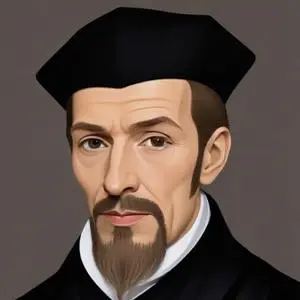
A French pastor and theologian who played a key role in the Protestant Reformation, shaping Christian theology and influencing Western civilization. He's famous for his teachings on predestination and his role in establishing Calvinism.
John Calvin, a renowned French theologian, pastor, and reformer, is widely regarded as one of the most influential figures of the Protestant Reformation. He is famously known for developing the system of Christian theology later called Calvinism, which emphasizes predestination and God's absolute sovereignty in the salvation of humanity.
Born on July 10, 1509, in Noyon, Picardy, France, Calvin was raised in a devout Catholic family. He received a humanist education, studying law at the University of Orléans and later at the University of Bourges. However, it was during his time at the University of Paris that Calvin was exposed to the ideas of the Protestant Reformation, which would eventually lead him to break away from the Roman Catholic Church.
In 1530, Calvin converted to Protestantism, and soon after, he fled to Basel, Switzerland, to escape persecution in France. It was in Basel that Calvin published the first edition of his seminal work, Institutes of the Christian Religion, in 1536. This comprehensive treatise on Christian theology established Calvin as a leading voice in the Reformation.
In 1536, Calvin was recruited by French reformer William Farel to join the Reformation in Geneva, Switzerland. However, due to resistance from the governing council, Calvin was expelled from the city in 1538. He then proceeded to Strasbourg, where he became the minister of a church of French refugees. During his time in Strasbourg, Calvin continued to support the reform movement in Geneva and was eventually invited back to lead the church of the city in 1541.
Calvin's theological contributions are far-reaching and profound. He is perhaps best known for his doctrine of predestination, which posits that God has predetermined the salvation of humanity. Additionally, Calvin emphasized the authority of Scripture, the importance of faith, and the role of the church in the lives of believers. His Institutes of the Christian Religion remains a foundational text of Reformed theology to this day.
Calvin's influence extends far beyond the realm of theology. His ideas have had a significant impact on Western society, shaping modern democracy, capitalism, and education. The Calvinist emphasis on hard work, thrift, and education has contributed to the development of modern capitalism, while his advocacy for representative government and the separation of church and state have influenced democratic systems around the world.
Calvin was not without controversy during his lifetime. He was a polemicist and apologetic writer, generating much debate and criticism from his contemporaries. His views on predestination and the role of the church in Geneva sparked intense debate, and he was often at odds with the governing council of the city. Despite these controversies, Calvin remains a revered figure in Christian history, and his legacy continues to shape the lives of millions around the world.
John Calvin's legacy is profound and far-reaching. He is remembered as a tireless advocate for reform, a passionate preacher, and a pioneering theologian. His influence can be seen in the development of Reformed and Presbyterian churches around the world, and his ideas continue to shape Christian theology and practice to this day. As a testament to his enduring impact, Calvin's Institutes of the Christian Religion remains a fundamental text of Christian theology, inspiring generations of scholars, theologians, and believers alike.
Born in 1483
A German monk and priest who sparked the Protestant Reformation, challenging Catholic Church authority and shaping Western Christianity. He's famous for nailing 95 theses to a church door, sparking a religious revolution.
Born in 1484
Leader of the Swiss Reformation, advocating for church reform and inspiring other Protestant movements.
Born in 1519
A 16th-century French theologian and scholar who played a key role in shaping Protestantism, particularly Calvinism, through his writings and teachings. He's also known for his Greek New Testament translation.
Born in 1497
A 16th-century Renaissance scholar who made significant contributions to the development of the Protestant Reformation and education, known for his theological writings and astronomical observations.
Born in 1491
Founded the Jesuit Order, a Catholic religious organization known for its missionary and educational work, and developed the Spiritual Exercises, a guide for spiritual growth and discernment.
