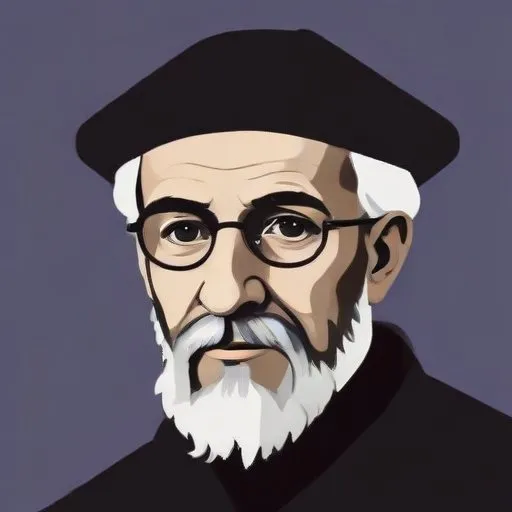
Theodore Beza: The Calvinist Reformer Who Shaped the Protestant Reformation
Theodore Beza, a French Calvinist theologian, played a pivotal role in the Protestant Reformation, succeeding
John Calvin as the spiritual leader of the Republic of Geneva. Beza's influence on Calvinism and his rigorous biblical scholarship earned him recognition as one of the most important figures of the 16th century Protestant Reformation.
Early Life and Education
Born on June 24, 1519, in Vzelay, Burgundy, France, Beza was descended from a noble family. His father, Pierre de Beze, was the royal governor of Vzelay, and his mother, Marie Bourdelot, was known for her generosity. Beza's uncle, Nicholas, a member of Parliament in Paris, recognized his nephew's intellectual potential and took him under his wing, educating him in Paris and later in Orlans.
Theological Contributions and Writings
Beza's theological contributions were instrumental in shaping Calvinism. He wrote extensively on biblical interpretation, producing commentaries on the New Testament and several books on theology. His most notable work,
De Haereticis, a Civili Magistratu Puniendis Disputatio, presented a detailed argument for the persecution of heretics, sparking controversy and debate among Protestant reformers. Beza's writings also included Icones, a collection of portraits of prominent reformers, and Epistola Pauli ad Romanos, a commentary on Paul's Epistle to the Romans.
Leadership and Controversies
In 1564, Beza succeeded John Calvin as the spiritual leader of the Republic of Geneva, a position he held until his death in 1605. During his tenure, Beza navigated the tumultuous landscape of Reformation-era politics, facing opposition from both Catholic and Protestant factions. He played a key role in the development of the Consensus Tigurinus, a theological statement that united the Reformed churches of Switzerland.
Personal Relationships and Anecdotes
Beza's relationship with John Calvin was marked by admiration and respect. He often sought Calvin's counsel and was deeply affected by Calvin's death in 1564. Beza's own marriage to Claude de Bassen ended in tragedy when his wife passed away in 1588, leaving him to care for their two daughters.
Legacy and Impact
Theodore Beza's legacy extends far beyond his own writings and theological contributions. He played a crucial role in shaping the Reformed tradition, influencing prominent theologians such as William Whitaker and John Owen. Beza's emphasis on biblical scholarship and his rigorous exegetical method paved the way for future generations of Protestant theologians.
- Beza's writings were translated into multiple languages, including Latin, French, and German, demonstrating his far-reaching influence across Europe.
- His commentary on the New Testament remains a significant resource for biblical scholars to this day.
Historical Context and Comparative Analysis
Theodore Beza's life and work must be understood within the tumultuous context of the Protestant Reformation. Beza's Calvinist convictions positioned him alongside prominent reformers such as John Knox and Heinrich Bullinger, while his rigorously biblical approach to theology set him apart from more radical Protestant factions.
Philosophical Contributions and Beliefs
Beza's theological contributions were rooted in his commitment to biblical authority and his emphasis on the sovereignty of God. He believed that Scripture was the ultimate authority in all matters of faith and morals, and his writings reflected this conviction.
Visual Timeline and Milestones
| 1519 |
Theodore Beza born in Vzelay, Burgundy, France |
| 1528 |
Beza begins studies under Melchior Wolmar in Orlans |
| 1534 |
Beza follows Wolmar to Bourges, where he is exposed to the Reformation movement |
| 1539 |
Beza receives his licentiate in law from Orlans |
| 1564 |
Beza succeeds John Calvin as the spiritual leader of the Republic of Geneva |
| 1605 |
Theodore Beza dies on October 13, leaving behind a legacy of theological scholarship and leadership |
Trivia and Fun Facts
- Beza's love for classical literature led him to compose Latin poetry in his youth.
- He was known for his exceptional linguistic skills, mastering Latin, Greek, and Hebrew.
Theodore Beza's life and work continue to inspire and challenge scholars, theologians, and lay readers alike. His commitment to biblical authority, his rigorous scholarship, and his leadership during a tumultuous era of Christian history have cemented his place as one of the most important figures of the Protestant Reformation.
FAQ
Who was Theodore Beza?
Theodore Beza was a French theologian and scholar, known for his work as a Protestant Reformer during the 16th century. He was a prominent figure in the development of Calvinism in France and Switzerland.
What were Theodore Bezas theological contributions?
Theodore Bezas theological contributions include his work on the Geneva Bible, as well as his role in shaping Calvinist theology and practice in France and Switzerland. He was a close associate of John Calvin and helped to spread his teachings.
How did Theodore Beza influence the Protestant Reformation?
Theodore Beza influenced the Protestant Reformation by providing theological and pastoral support to John Calvin and other reformers. He helped to establish Calvinist churches and institutions throughout France and Switzerland.
What was Theodore Bezas relationship with John Calvin?
Theodore Beza was a close friend, confidant, and collaborator of John Calvin, working closely with him to develop and spread Calvinist theology and practice.
What is Theodore Bezas legacy?
Theodore Bezas legacy is one of theological significance, as he played a key role in shaping the Calvinist Church and its teachings. He remains an important figure in Protestant theology and history.