


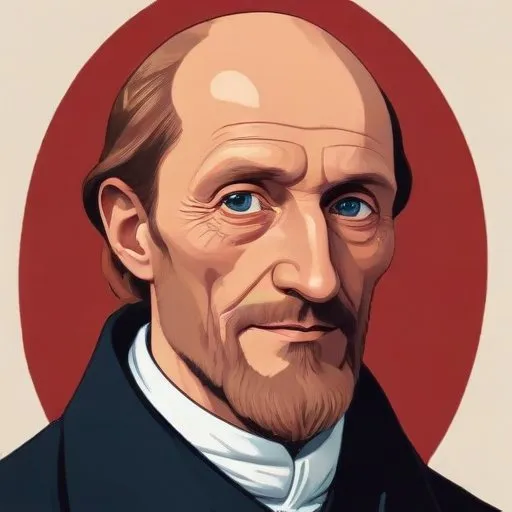
A 16th-century Renaissance scholar who made significant contributions to the development of the Protestant Reformation and education, known for his theological writings and astronomical observations.
Philip Melanchthon, a German Lutheran reformer, collaborator with Martin Luther, and the first systematic theologian of the Protestant Reformation, left an indelible mark on the religious landscape of the 16th century. As an intellectual leader of the Lutheran Reformation, he stands alongside Luther and John Calvin as a shaper of Protestantism.
Born Philipp Schwartzerdt on February 16, 1497, in Bretten, Germany, Melanchthon's early life was marked by tragedy when his father and grandfather died within eleven days of each other in 1508. He was sent to the Latin school at Pforzheim, where he was introduced to the Latin and Greek poets and Aristotle by the rector, Georg Simler of Wimpfen.
It was during this time that he was influenced by his great-uncle, Johann Reuchlin, a Renaissance humanist, who suggested he change his surname from Schwartzerdt (meaning "black earth") to the Greek equivalent, Melanchthon. This transformation symbolized his transition from a rural upbringing to a life of intellectual pursuit.
Melanchthon's academic prowess earned him a place at the University of Heidelberg, where he studied philosophy, rhetoric, astronomy, and astrology. Denied a master's degree in 1512 due to his youth, he moved to Tübingen, where he continued his humanistic studies, delving into jurisprudence, mathematics, and medicine.
His most notable work, Loci Communes Theologici (Commonplaces of Theology), published in 1521, solidified his position as a systematic theologian. This treatise presented a comprehensive and organized approach to Protestant theology, earning him recognition as a leading thinker of the Reformation.
Melanchthon's emphasis on education led to the development of new educational systems, which paved the way for modern pedagogy. His advocacy for the importance of classical languages, literature, and philosophy in education influenced the curricula of universities across Europe.
His diplomatic efforts to reconcile Lutheranism with Catholicism, although ultimately unsuccessful, facilitated dialogue and paved the way for future ecumenical discussions.
Melanchthon's contributions to the Protestant Reformation, education, and theology have left a lasting impact on Western Christianity. His legacy extends beyond his own lifetime, influencing notable figures such as Johann Wolfgang von Goethe and Friedrich Schiller.
Today, Melanchthon remains an enigmatic figure, often overshadowed by his more charismatic counterpart, Martin Luther. However, his meticulous scholarship, diplomatic prowess, and commitment to education have secured his place as a pillar of the Protestant Reformation.
"The duty of the theologian is to speak of God, not to speak of himself."
"Wisdom is a virtue, and it is acquired by reading, not by mere observation."
Philip Melanchthon's remarkable life serves as a testament to the power of intellect, diplomacy, and conviction, inspiring generations to strive for knowledge, understanding, and faith.
Born in 1483
A German monk and priest who sparked the Protestant Reformation, challenging Catholic Church authority and shaping Western Christianity. He's famous for nailing 95 theses to a church door, sparking a religious revolution.
Born in 1509
A French pastor and theologian who played a key role in the Protestant Reformation, shaping Christian theology and influencing Western civilization. He's famous for his teachings on predestination and his role in establishing Calvinism.
Born in 1484
Leader of the Swiss Reformation, advocating for church reform and inspiring other Protestant movements.
Born in 1489
Leader of the English Reformation, instrumental in creating the Church of England and authoring the Book of Common Prayer.
Born in 1504
A prominent figure in the Swiss Reformation, he played a key role in shaping Protestant theology and wrote influential works on covenant theology. His writings had a lasting impact on Reformed Christianity.
