


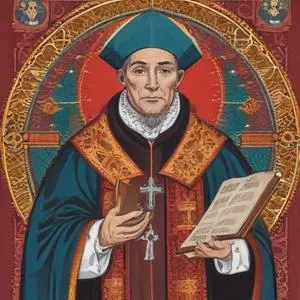
Leader of the English Reformation, instrumental in creating the Church of England and authoring the Book of Common Prayer.
Thomas Cranmer was a prominent figure in the English Reformation, serving as Archbishop of Canterbury during the reigns of Henry VIII, Edward VI, and Mary I. He is best known for his role in shaping the Church of England, drafting the Book of Common Prayer, and promoting the principles of royal supremacy.
Born on July 2, 1489, in Aslockton, Nottinghamshire, England, Cranmer was educated at Jesus College, Cambridge, where he earned his Bachelor's and Master's degrees. He later studied theology at Jesus College, Cambridge, and was ordained as a priest in 1523.
Cranmer's involvement in the English Reformation began when he was recruited by King Henry VIII to help annul his marriage to Catherine of Aragon. Cranmer, along with Thomas Cromwell, supported the principle of royal supremacy, which declared the king sovereign over the Church within his realm. This led to the separation of the English Church from the Holy See.
In 1533, Cranmer was appointed Archbishop of Canterbury, a position he held until his execution in 1556. During his tenure, he established the first doctrinal and liturgical structures of the reformed Church of England. He published the first officially authorized vernacular service, the Exhortation and Litany, and wrote and compiled the first two editions of the Book of Common Prayer, a complete liturgy for the English Church.
Under King Edward VI's rule, Cranmer was able to promote major reforms, including changes to doctrine and discipline in areas such as the Eucharist, clerical celibacy, and the veneration of saints. He worked with Continental reformers, providing them refuge and collaborating on reforms. However, his reforms were met with resistance from religious conservatives, leading to power struggles and controversies.
After Mary I, a Catholic, ascended to the throne, Cranmer was put on trial for treason and heresy. Imprisoned for over two years, he made several recantations and reconciled himself with the Catholic Church. However, on the day of his execution, he withdrew his recantations, declaring his commitment to the principles of the English Reformation. He was burned at the stake on March 21, 1556.
Thomas Cranmer's legacy is complex and multifaceted. He is remembered as a martyr for the English Reformation, a promoter of Protestantism, and a key figure in shaping the Church of England. His reforms and writings continue to influence the Anglican Communion to this day.
"I will not be atraitor to the English Church, to which I have devoted my life."
"The Church of England is not a sect, but a reformed Catholic Church."
Cranmer's reforms and writings can be compared to those of other prominent reformers, such as Martin Luther and John Calvin. While they shared similar goals, Cranmer's approach was more moderate, seeking to reform the Church from within rather than splitting from it entirely.
Cranmer was known for his humility and kindness, earning the respect of his contemporaries. He was a close friend and advisor to King Edward VI, and his relationships with Continental reformers played a significant role in shaping his theology.
The English Reformation, of which Cranmer was a key figure, had far-reaching consequences for the Church, state, and society. His reforms and writings continue to shape the Anglican Communion, making him a significant figure in Christian history.
Born in 1457
First Tudor king of England, who ended the Wars of the Roses and established a strong, centralized government, bringing stability and prosperity to the country.
Born in 1478
A renowned Renaissance humanist and statesman who served as Lord Chancellor of England, famous for his literary work "Utopia" and his martyrdom for refusing to acknowledge the English monarch's supremacy over the Church.
Born in 1239
Conqueror of Wales and hammer of the Scots, he strengthened the English monarchy and established parliamentary representation.
Born in 1926
The monarch of the United Kingdom and its Commonwealth realms, serving as a unifying figurehead and symbol of national identity, while also carrying out various ceremonial and charitable duties.
Born in 1483
A German monk and priest who sparked the Protestant Reformation, challenging Catholic Church authority and shaping Western Christianity. He's famous for nailing 95 theses to a church door, sparking a religious revolution.
Born in 1509
A French pastor and theologian who played a key role in the Protestant Reformation, shaping Christian theology and influencing Western civilization. He's famous for his teachings on predestination and his role in establishing Calvinism.
