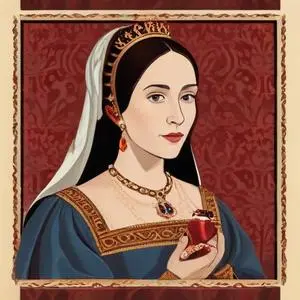
Catherine of Aragon: The Queen Who Defied the King
A Royal Reformer and Unyielding Matriarch
Catherine of Aragon is renowned for being the first wife of King Henry VIII, a marriage that lasted from 1509 until its annulment in 1533. She is also celebrated for her instrumental role in shaping English history, particularly in the realms of politics, religion, and women's empowerment.
The Early Years: A Princess of Aragon
Born on December 16, 1485, at the Archbishop's Palace of Alcalá de Henares, Catherine was the youngest child of
Isabella I of Castile and
Ferdinand II of Aragon. From a tender age, she was betrothed to
Arthur, Prince of Wales, and later married him in 1501. However, her life took an unexpected turn when her husband passed away just five months into their marriage.
Ambassador and Regent: Breaking Barriers
During her period of "limbo," Catherine held the distinguished position of ambassador of the Aragonese crown to England in 1507, becoming the first known female ambassador in European history. Later, she served as regent of England for six months in 1513, while Henry VIII was away in France. It was during this time that she demonstrated her leadership skills, delivering an impassioned speech about courage and patriotism, which played a significant role in the English victory at the Battle of Flodden.
A Marriage in Crisis: The Struggle for Supremacy
By 1526, Henry VIII's infatuation with Anne Boleyn had grown, and he became increasingly dissatisfied with Catherine's inability to produce a male heir. This led to a tumultuous period, as Henry sought to annul their marriage, citing the invalidity of their union due to her previous marriage to his older brother, Arthur. Catherine, however, refused to accept the annulment, citing the authority of the Catholic Church and her own legitimacy as the queen.
The English Reformation: A Queen's Defiance
Henry's defiance of the Pope's authority led to the English Reformation, with Henry assuming supremacy over religious matters in England. Catherine's steadfast refusal to accept this new order led to her eventual isolation and separation from her daughter, Mary. In 1533, their marriage was declared invalid, and Henry married Anne Boleyn, marking the beginning of a new era in English history.
Legacy: A Testament to Unwavering Conviction
Catherine of Aragon's unyielding commitment to her faith, her marriage, and her role as queen has left an indelible mark on English history. Her story serves as a testament to the power of conviction and the importance of standing up for one's beliefs, even in the face of overwhelming adversity.
- "I am his wife, and his wife I will remain, even if it means standing alone." - Catherine of Aragon
Personal Milestones and Key Life Events
- 1485: Born on December 16th at the Archbishop's Palace of Alcalá de Henares
- 1501: Married Arthur, Prince of Wales
- 1509: Married King Henry VIII
- 1513: Served as regent of England for six months
- 1526: Henry VIII's infatuation with Anne Boleyn grew, leading to a crisis in their marriage
- 1533: Marriage to Henry VIII declared invalid; Henry married Anne Boleyn
- 1536: Died on January 7th
Influence on Modern Society
Catherine of Aragon's legacy extends beyond her tumultuous marriage and her role in shaping English history. She has inspired generations of women to stand up for their rights and challenge patriarchal authority. Her story has also served as a catalyst for discussions on feminism, power dynamics, and the complexities of relationships.
Philosophical Contributions and Beliefs
Catherine's unyielding commitment to her faith and her marriage reflects her deep-seated convictions about the importance of tradition, authority, and personal integrity. Her beliefs have inspired numerous scholarly and literary works, cementing her place as a pioneering figure in the history of women's empowerment.
FAQ
Who was Catherine of Aragon?
Catherine of Aragon was the Queen of England from 1509 until 1533, as the first wife of King Henry VIII. She was the daughter of King Ferdinand II of Aragon and Queen Isabella I of Castile.
What was Catherine of Aragons role in English history?
Catherine of Aragon played a significant role in English history, particularly in the Tudor period. She was a patron of the arts and education, and established several charitable institutions.
Why did Catherine of Aragons marriage to Henry VIII end?
Catherine of Aragons marriage to Henry VIII ended because she failed to produce a male heir, leading Henry to seek an annulment. When the Pope refused to grant the annulment, Henry broke away from the Catholic Church, establishing the Church of England, with himself as its head.
What was Catherine of Aragons relationship with her daughter, Mary?
Catherine of Aragon was devoted to her daughter, Mary Tudor (later Mary I of England), and worked to ensure her education and upbringing. However, their relationship was strained due to Henry VIIIs desire to replace Catherine with Anne Boleyn.
How did Catherine of Aragon die?
Catherine of Aragon died on January 7, 1536, at the age of 50, at Kimbolton Castle in Cambridgeshire, England. She was buried in Peterborough Cathedral with the ceremony due to a princess, rather than a queen.