


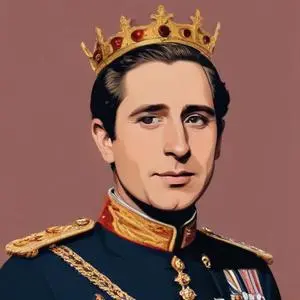
Eldest son of King Henry VII, first in line to the English throne, whose early death led to his brother Henry VIII's ascension. He was the embodiment of Tudor dynasty's hopes and expectations.
Arthur, Prince of Wales, was the eldest son of King Henry VII of England and Elizabeth of York, born on September 19, 1486. As the firstborn son, he was the heir apparent to the throne, carrying the hopes of the newly established House of Tudor on his shoulders.
Arthur was well-educated, receiving a privileged upbringing, and was created Prince of Wales and Earl of Chester in 1489. At a young age, he demonstrated a keen interest in learning, which earned him recognition as a promising student.
Plans for Arthur's marriage began before his third birthday, as part of a strategic effort to forge alliances with European powers. At the age of eleven, he was formally betrothed to Catherine of Aragon, a daughter of the powerful Catholic Monarchs in Spain, to secure an Anglo-Spanish alliance against France and Scotland.
Tragedy struck in 1501, when Arthur took up residence with Catherine at Ludlow Castle in Shropshire. Just six months later, he died, possibly due to the sweating sickness, which Catherine miraculously survived.
Arthur's untimely death had far-reaching consequences. One year later, Henry VII renewed his efforts to seal a marital alliance with Spain by arranging for Catherine to marry Arthur's younger brother Henry, who would eventually become King Henry VIII. The question of whether Arthur and Catherine had consummated their marriage would later become a contentious issue, exploited by Henry VIII and his court to cast doubt upon the validity of Catherine's union with Henry VIII, ultimately contributing to the separation between the Church of England and the Roman Catholic Church.
Although Arthur's life was cut short, his legacy extends beyond his brief-lived marriage and diplomatic endeavors. His story serves as a testament to the complexities of royal politics, the importance of strategic alliances, and the intrigue that often surrounded royal marriages in the medieval era.
In the grand tapestry of English history, Arthur, Prince of Wales, remains an intriguing figure, whose life was marked by both promise and tragedy. His story serves as a poignant reminder of the fragility of life and the unpredictability of fate, even for those born into royal privilege.
Born in 1457
First Tudor king of England, who ended the Wars of the Roses and established a strong, centralized government, bringing stability and prosperity to the country.
Born in 1239
Conqueror of Wales and hammer of the Scots, he strengthened the English monarchy and established parliamentary representation.
Born in 1926
The monarch of the United Kingdom and its Commonwealth realms, serving as a unifying figurehead and symbol of national identity, while also carrying out various ceremonial and charitable duties.
Born in 1542
The last Scottish monarch of the House of Stuart, she was a Catholic queen who faced Protestant rebellion and was eventually beheaded, sparking a centuries-long rivalry with England. She's known for her tumultuous reign and tragic fate.
Born in 1574
An English explorer and cartographer who mapped the New World and created innovative navigational tools, contributing significantly to the development of modern cartography.
