


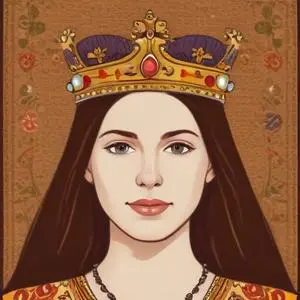
Daughter of King Edward IV, she married Henry VII, uniting the Houses of York and Lancaster, and was the mother of Henry VIII, establishing the Tudor dynasty.
Elizabeth of York, born on February 11, 1466, is renowned for being the Queen of England from her marriage to King Henry VII in 1486 until her death in 1503. She played a pivotal role in ending the Wars of the Roses, uniting the rival houses of Lancaster and York, and giving birth to a future king who would shape English history.
Elizabeth was born at the Palace of Westminster as the eldest child of King Edward IV and his wife, Elizabeth Woodville. Her christening was celebrated at Westminster Abbey, with her grandmothers, Jacquetta of Luxembourg, Duchess of Bedford, and Cecily Neville, Duchess of York, as sponsors.
After King Edward IV's sudden death in 1483, Elizabeth's uncle, Richard III, seized the throne. However, Henry Tudor, a Lancastrian claimant, saw an opportunity to unite the rival houses by marrying Elizabeth. In 1486, Henry Tudor defeated Richard III at the Battle of Bosworth Field and took the throne as Henry VII. He fulfilled his promise to marry Elizabeth, solidifying his claim to the throne and uniting the houses of Lancaster and York.
Elizabeth and Henry VII had seven children, including three sons and four daughters. Although three of their children died young, their eldest son, Arthur, Prince of Wales, was next in line to the throne. Tragically, he died at the age of 15 in 1502. Their second son, Henry VIII, would go on to become one of the most infamous kings in English history. Their daughters, Margaret and Mary, would become the queens of Scotland and France, respectively.
Unlike some of her contemporaries, Elizabeth seems to have played little part in politics, focusing instead on her family and domestic life. Her marriage to Henry VII was reportedly a happy and successful one, despite the tumultuous times in which they lived. Elizabeth's legacy lies in her role as a unifying figure, bringing together the rival houses of Lancaster and York and giving birth to a future king who would shape English history.
Elizabeth of York's life and marriage marked the end of the Wars of the Roses and the beginning of the Tudor dynasty, which would shape English history for over a century. Her legacy as a unifying figure and matriarch of the Tudor dynasty has endured for centuries, cementing her place as one of the most important women in English history.
Born in 1489
Daughter of an English king, she married a Scottish king, uniting the thrones and paving the way for the eventual union of the crowns. She played a key role in Scottish politics and cultural development.
Born in 1485
Spanish princess who became the queen consort of England, playing a central role in the English Reformation and sparking the creation of the Church of England.
Born in 1239
Conqueror of Wales and hammer of the Scots, he strengthened the English monarchy and established parliamentary representation.
Born in 1926
The monarch of the United Kingdom and its Commonwealth realms, serving as a unifying figurehead and symbol of national identity, while also carrying out various ceremonial and charitable duties.
Born in 1478
A renowned Renaissance humanist and statesman who served as Lord Chancellor of England, famous for his literary work "Utopia" and his martyrdom for refusing to acknowledge the English monarch's supremacy over the Church.
