


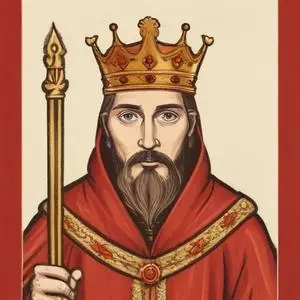
First Yorkist king of England, restoring stability after the Wars of the Roses, and establishing a strong, centralized government.
Edward IV, one of the most enigmatic and feared monarchs in English history, is best known for his role in the Wars of the Roses, a brutal dynastic struggle that ravaged medieval England. As the first Yorkist king of England, Edward's reign marked a significant shift in power and paved the way for the Tudor dynasty that followed.
Born on April 28, 1442, Edward IV was the eldest son of Richard, Duke of York, and Cecily Neville. His family's claim to the throne was rooted in his father's descent from Lionel, Duke of Clarence, the second son of King Edward III. This lineage made Edward a legitimate contender for the crown, which was then held by the Lancastrian king, Henry VI.
In 1455, Edward's father, Richard, was killed at the Battle of Wakefield, which sparked the Wars of the Roses. Edward, then just 13 years old, was determined to avenge his father's death and claim the throne. He rallied the Yorkist forces and, after a series of bloody battles, defeated the Lancastrians at the Battle of Towton in 1461, securing his place as king.
Edward IV's reign was marked by his pragmatic approach to governance and his efforts to reunite the warring factions. He implemented several reforms, including the establishment of a strong and centralized government, the creation of a new Peerage of England, and the promotion of trade and commerce.
One of Edward's most notable achievements was his marriage to Elizabeth Woodville, a commoner, in 1464. This union brought stability to the throne and strengthened England's ties with the powerful Woodville family.
Despite his efforts to consolidate power, Edward IV faced continued opposition from the Lancastrians and the French monarchy. In 1470, he was briefly deposed by the Earl of Warwick, known as the "Kingmaker," who restored Henry VI to the throne. However, Edward regained power in 1471 after defeating the Lancastrians at the Battle of Tewkesbury.
Edward IV's reign was eventually cut short by his sudden death on April 9, 1483. His 12-year-old son, Edward V, was declared king, but was soon deposed by his uncle, Richard III, who had Edward V and his younger brother, Richard, declared illegitimate. This paved the way for Henry Tudor to claim the throne, marking the beginning of the Tudor dynasty.
Edward IV's legacy is complex and multifaceted. While he was a skilled military leader and effective ruler, his reign was also marked by violence, betrayal, and bloodshed. Nevertheless, his reforms and policies laid the groundwork for the Tudor dynasty's success.
In the centuries that followed, Edward IV's reputation was tarnished by the Tudor propaganda machine, which sought to justify Henry VII's claim to the throne. However, in recent years, historians have reevaluated Edward's reign, recognizing his achievements and acknowledging his role in shaping English history.
Edward IV's story serves as a testament to the complexities of power, loyalty, and ambition in medieval England. While his reign was marked by turmoil and bloodshed, his legacy continues to fascinate and inspire us to this day.
Born in 1442
First Yorkist king of England, restoring stability after the Wars of the Roses, and establishing a strong, centralized government.
Born in 1430
Wife of King Henry VI of England, she played a significant role in the Wars of the Roses, leading the Lancastrian faction and fighting for her husband's claim to the throne.
73 Years Old
A British singer-songwriter and pianist known for his emotive, poetic lyrics and soaring melodies, crafting introspective and atmospheric indie-pop soundscapes.
