


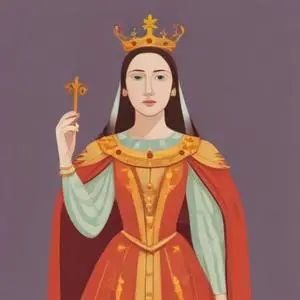
Wife of King Henry VI of England, she played a significant role in the Wars of the Roses, leading the Lancastrian faction and fighting for her husband's claim to the throne.
Margaret of Anjou, the Queen of England from 1445 to 1461 and again from 1470 to 1471, was a force to be reckoned with in the tumultuous landscape of 15th-century politics. Known for her valiant courage, undaunted spirit, and shrewd policy, she personally led the Lancastrian faction in the devastating Wars of the Roses, earning her a reputation as one of the most formidable women of her time.
Born on March 23, 1430, at Pont-à-Mousson in Lorraine, Margaret was the second daughter of René, King of Naples, and Isabella, Duchess of Lorraine. Her upbringing in the House of Valois-Anjou, a cadet branch of the French royal family, instilled in her a sense of royal ambition and a fierce determination to secure her family's interests.
In 1445, Margaret married King Henry VI of England, solidifying her position as Queen of England and, nominally, Queen of France. However, her husband's frequent bouts of insanity soon thrust her into the role of de facto ruler, navigating the treacherous waters of English politics and intrigue.
Margaret's natural aptitude for politics and governance earned her widespread respect. She attended council meetings, issued writs, and even led troops into battle, exhibiting a level of courage and strategic prowess that belied her sex. Her contemporaries, including the Duke of Suffolk, praised her "valiant courage and undaunted spirit."
The Wars of the Roses, a devastating series of civil wars that ravaged England for over three decades, were sparked in part by Margaret's exclusion of the Yorkist faction from the Great Council in May 1455. This fateful decision ignited a conflict that would claim the lives of thousands, including her only son, Edward of Westminster, Prince of Wales, at the Battle of Tewkesbury in 1471.
Following the Lancastrian defeat at Tewkesbury, Margaret was taken prisoner by the victorious Yorkists. In 1475, she was ransomed by her cousin, King Louis XI of France, and forced to live in France as a poor relation of the French monarch.
Margaret of Anjou's remarkable life, marked by both triumph and tragedy, serves as a testament to her unwavering dedication to her family and her kingdom. Though her legacy is often overshadowed by the tumultuous era in which she lived, her steel-hearted courage, political acumen, and unyielding spirit have earned her a place among the most fascinating and influential women of the medieval period.
Despite the turmoil that surrounded her, Margaret of Anjou remains an enigmatic figure, a testament to the enduring power of determination and courage in the face of adversity.
Born in 1133
King of England from 1154 to 1189, known for establishing a strong centralized government, reforming the English church, and his tumultuous relationships with Thomas Becket and his sons.
Born in 1284
The king whose disastrous reign led to his eventual deposition and mysterious death, remembered for his alleged homosexual relationships and power struggles with nobles.
Born in 1367
The last king of the House of Plantagenet, deposed in a coup, known for his extravagance and tyranny, leading to his downfall and the rise of the Lancastrian dynasty.
Born in 1710
The monarch who ruled France from 1715 to 1774, known as the "Sun King's" great-grandson, and remembered for his extravagance, absolutism, and the decline of the French monarchy.
Born in 1403
King of France from 1422 to 1461, he played a crucial role in ending the Hundred Years' War by expelling the English from French territory. He also established a strong centralized government.
Born in 1412
A French heroine who led the French army to several victories during the Hundred Years' War, and was later canonized as a saint after being burned at the stake for heresy.
