


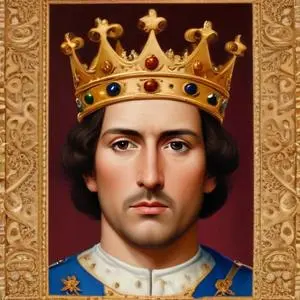
The last king of the House of Plantagenet, deposed in a coup, known for his extravagance and tyranny, leading to his downfall and the rise of the Lancastrian dynasty.
Richard II, also known as Richard of Bordeaux, is remembered as one of the most enigmatic and tumultuous kings in English history. He ruled England from 1377 to 1399, a period marked by power struggles, rebellions, and artistic flourishing.
Born on January 6, 1367, Richard was the son of Edward, Prince of Wales (the Black Prince), and Joan, Countess of Kent. Following his father's death in 1376, Richard became heir apparent to his grandfather, King Edward III. When Edward III passed away, the 10-year-old Richard succeeded to the throne, with government placed in the hands of regency councils influenced by his uncles John of Gaunt and Thomas of Woodstock.
England faced numerous problems during Richard's early reign, including the ongoing Hundred Years' War with France. The Peasants' Revolt in 1381 posed a significant threat to the monarchy, but the young king played a crucial role in its suppression. Unlike his warlike ancestors, Richard sought to end the Hundred Years' War, opting for a more conciliatory approach.
Richard was a patron of the arts, fostering a refined atmosphere at court that celebrated art, literature, and culture. He believed in the royal prerogative, limiting the power of the nobility and relying on a private retinue for military protection. This approach led to discontent among the aristocracy, who saw the king's dependence on a small circle of courtiers as a threat to their influence.
In 1387, a group of aristocrats known as the Lords Appellant seized control of the government, largely in response to Richard's perceived autocracy. By 1389, the king had regained control, and for the next eight years, he governed in relative harmony with his former opponents. However, in 1397, Richard exacted revenge on the Appellants, executing or exiling many of them.
The next two years of Richard's reign have been characterized as a period of tyranny. In 1399, after John of Gaunt's death, the king disinherited Gaunt's son, Henry Bolingbroke, who had previously been exiled. Henry invaded England in June 1399, gathering a significant following and ultimately deposing Richard. Henry was crowned king, marking the end of Richard's tumultuous reign.
Richard II's reign was marked by contradictions: a patron of the arts, yet prone to authoritarianism; a seeker of peace, yet vulnerable to the whims of his nobles. His legacy serves as a reminder of the complexities of medieval politics and the fragility of power.
"I am the king, and I will be obeyed." - Richard II
Richard II's legacy can be seen in the development of English literature and art, as well as the evolution of the English monarchy. His tumultuous reign serves as a reminder of the importance of balancing power and accountability.
Born in 1340
A powerful and wealthy medieval English nobleman, known for his immense influence on English politics and his role in the Hundred Years' War. He was also a patron of the arts and a founder of Trinity College, Cambridge.
Born in 1330
The eldest son of King Edward III, he was a renowned military leader and heir to the English throne, famous for his victories in the Hundred Years' War, particularly the Battle of Poitiers. He was also known for his chivalry and founding the Order of the Garter.
Born in 1133
King of England from 1154 to 1189, known for establishing a strong centralized government, reforming the English church, and his tumultuous relationships with Thomas Becket and his sons.
Born in 1386
Led a victorious English army in the Battle of Agincourt, a major English victory in the Hundred Years' War, and was a popular king who strengthened the English monarchy.
Born in 1284
The king whose disastrous reign led to his eventual deposition and mysterious death, remembered for his alleged homosexual relationships and power struggles with nobles.
Born in 1314
The queen who brought Flemish weavers to England, revitalizing the country's textile industry, and was a devoted wife to King Edward III, supporting him throughout his reign.
