


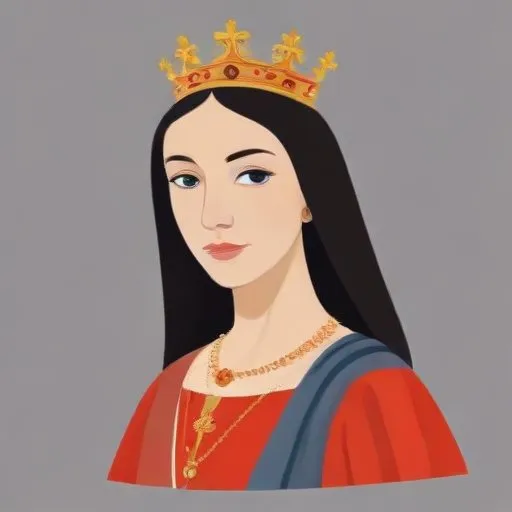
The queen who brought Flemish weavers to England, revitalizing the country's textile industry, and was a devoted wife to King Edward III, supporting him throughout his reign.
Philippa of Hainault, the 14th-century queen of England, is renowned for her remarkable influence on King Edward III's reign, her tireless efforts in promoting commercial expansion, and her compassionate nature that won the hearts of the English people.
Philippa was born on June 24, 1310 or 1315, in Valenciennes, Low Countries, to Count William of Hainaut and French princess Joan of Valois. As one of eight children and the second of five daughters, Philippa was part of the Royal House of Valois, a cadet branch of the Capetian dynasty.
In 1326, Philippa was engaged to Edward, Prince of Wales, as part of a diplomatic effort to forge an alliance between England and Flanders. Their marriage took place in York Minster on January 24, 1328, soon after Edward's accession to the English throne.
Philippa's influence extended far beyond the traditional role of a queen consort. In 1346, she acted as regent while her husband was away fighting in the Hundred Years' War. Her sound judgment and astute diplomacy helped maintain peace and stability in England during this tumultuous period.
Philippa's interest in commercial expansion led her to encourage King Edward to focus on the nation's economic growth. Her efforts contributed to the successful Battle of Nevilles Cross and numerous expeditions to Scotland and France.
In 1347, Philippa's compassion and humanity shone brightly when she persuaded King Edward to spare the lives of the Burghers of Calais. This act of mercy earned her immense popularity among the English people, cementing her place as a beloved queen.
Philippa and King Edward had twelve children together, ensuring a long and stable reign for the House of Plantagenet. Her legacy extends beyond her royal duties, inspiring future generations with her unwavering commitment to peace, commerce, and compassion.
Philippa's life and legacy are set against the backdrop of the Hundred Years' War and the tumultuous reign of King Edward III. Her diplomatic efforts, commercial vision, and compassion helped maintain peace and stability in England, solidifying her place as one of the most influential queens in English history.
Philippa of Hainault's remarkable story serves as a testament to the power of intelligent leadership, compassion, and determination, leaving an indelible mark on the pages of history.
Born in 1284
The king whose disastrous reign led to his eventual deposition and mysterious death, remembered for his alleged homosexual relationships and power struggles with nobles.
Born in 1340
A powerful and wealthy medieval English nobleman, known for his immense influence on English politics and his role in the Hundred Years' War. He was also a patron of the arts and a founder of Trinity College, Cambridge.
Born in 1345
A member of the royal House of Lancaster, she was a patron of the arts and a powerful noblewoman who played a significant role in 14th-century English politics. Her legacy has endured through literature and art.
