


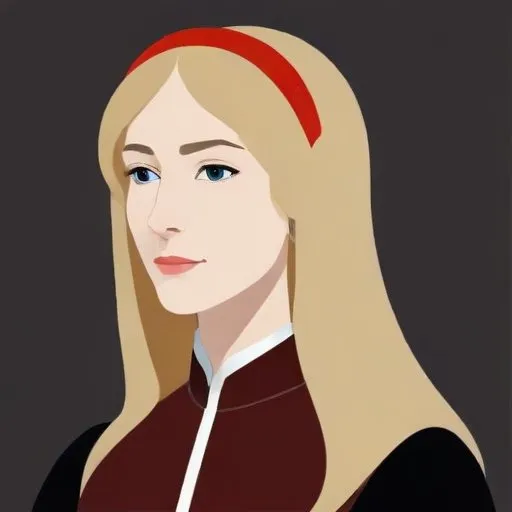
A member of the royal House of Lancaster, she was a patron of the arts and a powerful noblewoman who played a significant role in 14th-century English politics. Her legacy has endured through literature and art.
Blanche of Lancaster, a member of the English royal House of Lancaster, is renowned for being the first wife of John of Gaunt, the mother of King Henry IV, and the grandmother of King Henry V of England. Her significant lineage and marriages catapulted her to a position of great power and influence in medieval England.
Blanche was born on 25 March 1342 at Bolingbroke Castle in Lindsey, the younger daughter of Henry of Grosmont, 1st Duke of Lancaster, and his wife Isabel de Beaumont. Her elder sister, Maud, Countess of Leicester, would eventually marry Ralph de Stafford and then William I, Duke of Bavaria, but leave no surviving children, paving the way for Blanche to inherit her father's titles and vast estates.
On 19 May 1359, Blanche married her third cousin, John of Gaunt, fourth son of King Edward III, at Reading Abbey in Berkshire. The lavish wedding was attended by the entire royal family, and King Edward III bestowed upon Blanche exquisite gifts of jewelry. Following her father's death without male heirs in 1361, the title Duke of Lancaster became extinct, but John of Gaunt became Earl of Lancaster, Earl of Derby, Earl of Lincoln, and Earl of Leicester, thanks to his marriage to Blanche.
The French chronicler Jean Froissart described Blanche as "jone et jolie" (young and pretty) after her passing. The celebrated poet Geoffrey Chaucer was also inspired by Blanche, making her the central figure in his Book of the Duchess. Her beauty, grace, and influential position in society made her a renowned figure in medieval England.
Blanche's marriage to John of Gaunt and her inheritance of her father's titles and estates laid the foundation for the House of Lancaster's rise to power. Her son, King Henry IV, would go on to play a pivotal role in shaping English history, and her grandson, King Henry V, would lead the English to victory in the Hundred Years' War. Blanche's impact on the English monarchy and her role in shaping the course of history are undeniable.
Blanche of Lancaster's remarkable life and legacy have left an indelible mark on English history. Her influential position, beauty, and strong character have inspired generations, solidifying her place as one of the most fascinating figures of medieval England.
Born in 1340
A powerful and wealthy medieval English nobleman, known for his immense influence on English politics and his role in the Hundred Years' War. He was also a patron of the arts and a founder of Trinity College, Cambridge.
Born in 1284
The king whose disastrous reign led to his eventual deposition and mysterious death, remembered for his alleged homosexual relationships and power struggles with nobles.
Born in 1330
The eldest son of King Edward III, he was a renowned military leader and heir to the English throne, famous for his victories in the Hundred Years' War, particularly the Battle of Poitiers. He was also known for his chivalry and founding the Order of the Garter.
Born in 1133
King of England from 1154 to 1189, known for establishing a strong centralized government, reforming the English church, and his tumultuous relationships with Thomas Becket and his sons.
Born in 1386
Led a victorious English army in the Battle of Agincourt, a major English victory in the Hundred Years' War, and was a popular king who strengthened the English monarchy.
